Showing posts with label feminism. Show all posts

Sunday, February 16, 2014

{review} dumps: a plain girl

L. T. Meade Dumps: A Plain Girl (1905)


I am going to tell the story of my life as far as I can; but before I begin I must say that I do wonder why girls, as a rule, have a harder time of it than boys, and why they learn quite early in life to be patient and to give up their own will.
I'm not sure this is a review; more of an extended laugh at one of the best book titles I've encountered for ages. I mean, REALLY, "Dumps: A Plain Girl"? One almost doesn't need to read the book - surely it is quite plain (ho ho) what happens in this one.
...but he said the true name for me ought not to be Rachel, but Dumps, and how could any girl expect to rule over either boys or girls with such a name as Dumps? I suppose I was a little stodgy in my build, but father said I might grow out of that, for my mother was tall.
This is my second read of an L. T. Meade book: I started with A Sweet Girl Graduate, because I am interested in the history of women's colleges (having attended one), and I was hooked on Meade's blend of sickly sentimentality and sober evangelism for educating girls. I chose Dumps because of the title, though I was tossing up about Polly: A New Fashioned Girl. Happily there are plenty of Meade titles out there to keep me going forever (she wrote over 300 books).

So, poor little Dumps. Yes, Dumps is a plain girl. And she lives a rather plain life with her widowed father, who is a genius, but quite poor --
He was also somewhat of a saving turn of mind, and he told me once that he was putting by money in order to help the boys to go to one of the ’varsities by-and-by. He was determined that they should be scholars and gentlemen; and of course I thought this a very praiseworthy ambition of his, and offered to do without a new summer dress. He did not even thank me; he said that he thought I could do quite well with my present clothes for some time to come, and after that I felt my sacrifice had fallen somewhat flat.
-- and her brothers and a faithful but slovenly servant.

Dumps' life is a lonely one:
"And a girl's little brain is meant to keep a house comfortable."
"But, father, I haven't such a little brain; and I think I could do something else."
"Could what?" said father, opening his eyes with horror. "What in the world is more necessary for a girl who is one day to be a woman than to know how to keep a house comfortable?"
"Yes, yes," I said; "I suppose so." I was very easily stopped when father spoke in that high key.
Given Meade's support of feminist causes, I was hopeful that he would be struck by lightning at this point, but no such luck.
I really was a very stranded sort of girl. Hitherto I had had no outlets of any sort; I was just Dumps, a squat, rather plain girl, who knew little or nothing of the world—a neglected sort of girl, I have no doubt; but then I had no mother.
And then... one day a mysterious lady comes to visit, then invites Dumps to stay with her for a holiday, and easily wins the poor girl over with nice clothes and plenty of food and gentle kindnesses. But what lies behind this kindly lady's unexpected generosity? I'm not going to tell you any more, but Dumps has her world-view considerably widened and learns some important lessons about life and herself. Also, we are happy to learn, getting enough to eat really helps with her looks.

And I don't think I can end without mentioning Dumps' first friend, the blue-stocking Augusta:
"Do let us walk about," I said, “and let us be chums, if you don’t mind."
"Chums?" said Augusta, turning her dreamy, wonderful eyes upon my face.
"Yes," I said.
"But chums have tastes in common," was her next remark.
"Well, you are very fond of books, are you not?" I said.
"Fond of books!" cried Augusta. "Fond of books! I love them. But that is not the right word: I reverence them; I have a passion for them." She looked hurriedly round her. "I shall never marry," she continued in a low whisper, "but I shall surround myself with books - the books of the great departed; their words, their thoughts, shall fill my brain and my heart. I shall be satisfied; nothing else will satisfy me but books, books, books!"
So, not great literature by any means, but an entertaining, often sad, rather sentimental bit of fiction. Dumps was a bit whingy (though she certainly had grounds for that!), and I didn't think it was as satisfying as A Sweet Girl Graduate - where there is also a lot of rather melodramatic and silly action but the theme of the importance of educating girls is never lost. 

Incidentally, Jane at fleur in her world has also recently reviewed another Meade title, A World of Girls. I have also been following a couple of blogs which constantly offer new lost wonders to explore, and I'd single out redeeming qualities and leaves and pages - there are so many great free e-treasures out there that I many never need to buy a book again. 

Tuesday, December 3, 2013

{reviews} herland

Charlotte Perkins Gilman Herland (1915).


We were now well used to seeing women not as females but as people; people of all sorts, doing every kind of work.
This is a fascinating book, and there's surely a lot one could say about it as a landmark feminist text from a time when women's rights were widely curtailed. 

Three male explorers set out to discover the truth about a legendary Land of Women, and in the process discover some rather unpleasant truths about their own land of men. As they set out, they only half-believe that such a world could exist:
"They would fight among themselves," Terry insisted. "Women always do. We mustn't look to find any sort of order and organization."
"You're dead wrong," Jeff told him. "It will be like a nunnery under an abbess - a peaceful, harmonious sisterhood."
I snorted derision at this idea. "Nuns, indeed! Your peaceful sisterhoods were all celibate, Jeff, and under vows of obedience. These are just women, and mothers, and where there's motherhood you don't find sisterhood - not much."
"No, sir - they'll scrap," agreed Terry. "Also we mustn't look for inventions and progress; it'll be awfully primitive."
When they do stumble upon this new world, they discover a female utopia: an ideal society, one entire ruled by women for women, with major advances in many sciences, and filled with women with a thirst for knowledge. It is also a society resistant to the 'accomplishments' of men. There are no men. This society's central tenet is one of the worship of motherhood, with birth occurring through parthenogenesis: "When a woman chose to be a mother, she allowed the child-longing to grow within her till it worked its natural miracle. When she did not so choose she put the whole thing out of her mind, and fed her heart with the other babies."

The narrator quickly has almost all of his preconceptions ("in our easy assumption of superiority") crushed about what makes an ideal society:
As I learned more and more to appreciate what these women had accomplished, the less proud I was of what we, with all our manhood, had done. You see, they had had no wars. They had had no kings, and no priests, and no aristocracies. They were sisters, and as they grew, they grew together - not by competition, but by united action.
The narrator is a sensible man ("I had not come to the country with any Turkish-harem intentions") – he wants to learn more and to attempt not to let on too much about how this society ("they had no horrible ideas") is making him feel about his own society. He is discussing how the women limit the number of their off-spring:
"But what I do not understand, naturally, is how you prevent it. I gathered that each woman had five. You have no tyrannical husbands to hold in check—and you surely do not destroy the unborn--"
The look of ghastly horror she gave me I shall never forget. She started from her chair, pale, her eyes blazing. "Destroy the unborn—!" she said in a hard whisper. "Do men do that in your country?"
"Men!" I began to answer, rather hotly, and then saw the gulf before me. None of us wanted these women to think that OUR women, of whom we boasted so proudly, were in any way inferior to them. I am ashamed to say that I equivocated. I told her of certain criminal types of women—perverts, or crazy, who had been known to commit infanticide.
His two companions act as foils to his desire to be fully and scientifically enlightened:
"What are you going to do with it when you do find it - if you do?" Jeff asked mildly.
Jeff was a tender soul. I think he thought that country - if there was one - was just blossoming with roses and babies and canaries and tidies, and all that sort of thing. And Terry, in his secret heart, had visions of a sort of sublimated summer resort - just Girls and Girls and Girls - and that he was going to be - well, Terry was popular among women even when there were other men around, and it's not to be wondered at that he had pleasant dreams of what might happen. I could see it in his eyes as he lay there, looking at the long blue rollers slipping by, and fingering that impressive mustache of his.
Of his two companions, Jeff is highly idealistic about women, with "gentle romantic old-fashioned notions of women as clinging vines"; this is, of course, another face of the masculine "assumption of superiority", but with Jeff the result is a sort of un-manning: "so deeply convinced of the almost supernatural advantages of this country and people, that he took his medicine like a—I cannot say "like a man," but more as if he wasn't one."

Terry, however, is a catastrophe waiting to happen. The language used of him by his companions hints at who is really primitive: the virgins who have evolved into a self-sufficient society, or the he-man who cannot believe any woman would not want him: "I always liked Terry. He was a man's man, very much so, generous and brave and clever; but I don't think any of us in college days was quite pleased to have him with our sisters." 

Terry is incapable of understanding that there is no place for him in this society; even worse, from his perspective, these women are not 'feminine':
As to Terry's criticism, it was true. These women, whose essential distinction of motherhood was the dominant note of their whole culture, were strikingly deficient in what we call "femininity." This led me very promptly to the conviction that those "feminine charms" we are so fond of are not feminine at all, but mere reflected masculinity - developed to please us because they had to please us, and in no way essential to the real fulfillment of their great process.
And these women do not play by the rules of male society:
Terry put in practice his pet conviction that a woman loves to be mastered, and by sheer brute force, in all the pride and passion of his intense masculinity, he tried to master this woman. It did not work.
"It did not work." That is such a defining moment in the clash of the two societies, but I'm not going to spill any more beans about this absolutely fascinating early feminist text.
"Suppose there is a country of women only," Jeff had put it, over and over. "What'll they be like?"
And we had been cocksure as to the inevitable limitations, the faults and vices, of a lot of women. We had expected them to be given over to what we called "feminine vanity" - "frills and furbelows," and we found they had evolved a costume more perfect than the Chinese dress, richly beautiful when so desired, always useful, of unfailing dignity and good taste. We had expected a dull submissive monotony, and found a daring social inventiveness far beyond our own, and a mechanical and scientific development fully equal to ours. We had expected pettiness, and found a social consciousness besides which our nations looked like quarreling children - feebleminded ones at that. We had expected jealousy, and found a broad sisterly affection, a fair-minded intelligence, to which we could produce no parallel. We had expected hysteria, and found a standard of health and vigor, a calmness of temper, to which the habit of profanity, for instance, was impossible to explain - we tried it.
There is also a fair bit of creepy eugenics going on in the background which might give you a hint about a factor not noted in the narrator's praise: exactly how ruthless will this society of women be?

The only other writing by Perkins Gilman with which I am familiar is the excellent and spooky The Yellow Wall-paper. What else should I read?

Wednesday, May 29, 2013

{misc.} bookish travels

I've just had a lovely week off work, visiting Sydney. I managed quite a few bookish things - a fruitful trawl of a couple of second-hand bookshops...


Look! Two Persephones -- Cicely Hamilton's William, An Englishman; Monica Dickens' Mariana. Such a great find - second-hand they are as rare as hens' teeth in Australia. The others are: a Virago edition of Charlotte Mew's collected poetry and prose; Beryl Bainbridge's The Dressmaker; Marguerite Duras' The Lover; and Lisa Lang's Utopian Man (the fictionalised story of the founder of Melbourne's Cole's Book Arcade – reviewed by reading matters and anzlitlovers).

Some new book window-shopping (and buying)...


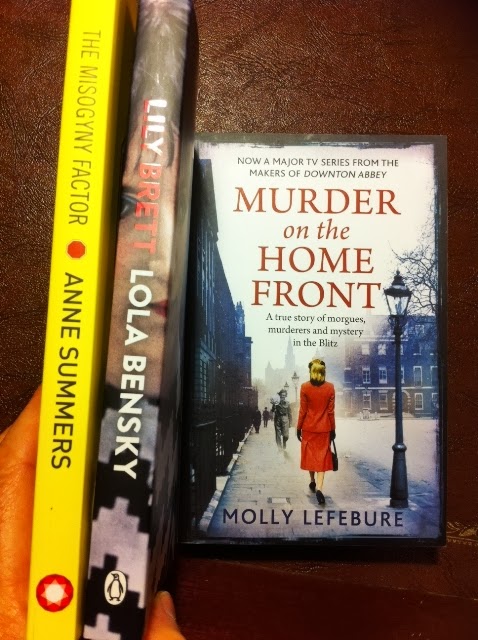
Here we see Anne Summers' The Misogyny Factor (for a taste of this take-down of misogyny in Australian public life, see her extraordinary talk (NSFW!) here. Also Lily Brett's Lola Bensky (which I wanted to read after enjoying travellinpenguin's review), and Murder on the Home Front by Molly Lefebure, based on her work as secretary to a forensic pathologist in London in World War Two.

A kind friend, knowing my love of vintage Australiana, gave me this wonderful old book - Possum by Mary Grant Bruce - about a sickly city family who embrace the health-filled delights of the bush:


I went to a couple of events at Sydney Writers' Festival. How's that for the view from one venue?


I managed to get along to three 'conversations' (a friendly format, I think): on Bohemian Sydney: Dancing with Empty Pockets with Tony Moore (author of a new book on bohemianism in Australia) and Elizabeth Farrelly; What the Classics Teach Us with Robert Greene, David Brooks, Richard Gill and Alastair Blanshard; and Fantastical Tales, with Sulari Gentill, Kate Forsyth, K.B. Hoyle and Judith Ridge. An eclectic mix, but all quite fascinating. Two of the three were free, too – a nice way to allow everyone access to some really good discussions.


I visited a couple of exhibitions, including Dressing Sydney at the Sydney Jewish Museum (about the origins of many familiar Australian fashion and design labels) and - my absolute favourite - the Lego Colosseum at the Nicholson Museum at the University of Sydney.


I ate a lot of cake, visiting both Black Star Pastry and Bourke Street Bakery:


And found a bottle of orgeat syrup, which I'm sure all Regency fans will recognise as a suitable Georgette Heyer-ish drink for ladies. I suspect Regency ladies did not drink it like this, however - the 'Japanese Cocktail' (brandy, orgeat, bitters, fresh lime. Amazing…):


I also gave a seminar paper at the university (terrifying but happily well received by a very kindly audience).

 
Sydney University, looking very handsome.

Of course, despite all of these bookish pursuits, I only finished one book - on the plane home! – the amusing tale of how a clever conman latches on to an unscrupulous millionaire and teaches him some lessons in humility (and frustration): An African Millionaire: Episodes in the Life of the Illustrious Colonel Clay by Grant Allen (who wrote one of my favourite reads this year, Miss Cayley's Adventures, also free at project gutenberg).

Finally, in the minus column, my laptop has died after a rapid and painful decline, so I have a backlog of about 30 million blog posts I want to comment on but can't until the replacement arrives. On the plus side, no one seems to have noticed that I'm writing this at work… Talk soon!

Monday, August 27, 2012

{review} the technology of orgasm

When did God make men?
When she realised that vibrators couldn't dance.

Maines' book is a really well adapted women's studies/social sciences dissertation. It is amusing and grotesque in almost equal measure. Maines looks at how the vibrator has been used, abused and misused as a 'scientific' instrument for managing women's illnesses by mechanical means, particularly in the nineteenth century. Some of these mechanisms are quite eye-watering: the steam-powered vibrator, is a case in point. Did you know that the vibrator was electrified for the home market nine years before the vacuum cleaner?!
Rests, strengthens, renews, repairs. Every vital organ is crammed full of vitality. The clogging waste is swept away by the coursing blood which the marvellous force sets leaping through every vein and artery with the virile strength of perfect health. You sleep as restfully as you used to. You awaken, refreshed mentally - physically - strong in mind and body and glad to be alive. [Advertisement for 'White Cross Electric Vibrator' in The American Magazine, January 1913]
Maines asks some really good questions: about the development of the 'disease paradigm' of hysteria; about women's diseases as cash cows for the unscrupulous; about the medicalization of normal conditions for reasons of belief and profit ("the patients neither recovered nor died of their condition but continued to require regular treatments"); about why there are so many hysterics in the nineteenth century; about the long-held belief that vaginal intercourse is required for orgasm (and the concomitant subsumption of the clitoris within "androcentric definitions of sexuality and the construction of ideal female sexuality to fit them"). And how can the same device cure nymphomania and frigidity?

Rating: this is a really enjoyable read, with some nice bits of gender and social theory made accessible to the general reader. There is no bibliography (which was sad), but the notes are very rich and worth reading in full.

If you liked this... I have this book on my wishlist: The Female Body in Medicine and Literature, edited by Andrew Mangham & Greta Depledge (2011).

Saturday, July 30, 2011

{weekend words}

Because people overeat for exactly the same reason they drink, smoke, serially fuck around or take drugs. I must be clear that I am not talking about the kind of overeating that’s just plain, cheerful greed – the kind of Rabelaisian, Falstaffian figures who treat the world as a series of sensory delights, and take full joy in their wine, bread and meat. Someone who walks away from a table – replete – shouting ‘THAT WAS SPLENDID!’, before sitting in front of a fire, drinking port and eating truffles, doesn’t have neuroses about food. They are in a consensual relationship with eating and, almost unfailingly, couldn’t care less about how it’s put an extra couple of stone on them. They tend to wear their weight well – luxuriously, like a fur coat, or a diamond sash – rather than nervously trying to hide it, or apologising for it. These people aren’t ‘fat’ – they are simply … lavish. They don’t have an eating problem – unless it’s running out of truffle oil, or finding a much-anticipated dish of razor clams sadly disappointing. No – I’m talking about those for whom the whole idea of food is not one of pleasure, but one of compulsion. For whom thoughts of food, and the effects of food, are the constant, dreary, background static to normal thought. Those who think about lunch whilst eating breakfast, and pudding as they eat crisps; who walk into the kitchen in a state bordering on panic, and breathlessly eat slice after slice of bread and butter – not tasting it, not even chewing – until the panic can be drowned in an almost meditative routine of spooning and swallowing, spooning and swallowing. In this trance-like state, you can find a welcome, temporary relief from thinking for ten, 20 minutes at a time, until, finally, a new set of sensations – physical discomfort, and immense regret – make you stop, in the same way you finally pass out on whisky, or dope. Overeating, or comfort eating, is the cheap, meek option for self-satisfaction, and self-obliteration. You get all the temporary release of drinking, fucking or taking drugs, but without – and I think this is the important bit – ever being left in a state where you can’t remain responsible and cogent. In a nutshell, then, by choosing food as your drug – sugar highs, or the deep, soporific calm of carbs, the Valium of the working classes – you can still make the packed lunches, do the school run, look after the baby, pop in on your mum and then stay up all night with an ill five-year-old – something that is not an option if you’re caning off a gigantic bag of skunk, or regularly climbing into the cupboard under the stairs and knocking back quarts of Scotch. Overeating is the addiction of choice of carers, and that’s why it’s come to be regarded as the lowest-ranking of all the addictions. It’s a way of fucking yourself up whilst still remaining fully functional, because you have to. Fat people aren’t indulging in the ‘luxury’ of their addiction making them useless, chaotic or a burden. Instead, they are slowly self-destructing in a way that doesn’t inconvenience anyone. And that’s why it’s so often a woman’s addiction of choice. All the quietly eating mums. All the KitKats in office drawers. All the unhappy moments, late at night, caught only in the fridge-light.

Caitlin Moran (2011)

How to be a Woman 

Wednesday, March 9, 2011

{review} stepford wives

Ira Levin The Stepford Wives (1972)


Ah, cultural memory. I've neither seen the films (1975; 2004) nor read the book before now but the concept of a 'Stepford Wife' is nevertheless embedded in my consciousness.
...Kit said, folding the T-shirt. "These thngs came out nice and white, didn't they?" She put the folded T-shirt into the laundry basket, smiling.
Like an actress in a commercial.
That's what she was, Joanna felt suddenly. That's what they all were, all the Stepford wives: actresses in commercials, pleased with detergents and floor wax, with cleansers, shampoos, and deodorants. Pretty actresses, big in the bosom but small in the talent, playing suburban housewives unconvincingly, too nicey-nice to be real.
This is a very clever little book - Levin takes contemporary anxieties about the effect of the feminist movement on women as home-makers and turns them into a horror story. The men in this book, for the most part, give lip service - and what often seems like far more than lip service - to the emancipation of women, but all along they're plotting. Against us... 

Joanna moves to the inordinately perfect town of Stepford (Connecticut) with her husband and child. She is a photographer who has had some successes with her work. Her husband is a traditional provider figure who goes off to the city to work, but he is keen to support her enterprises. This is, after all, the early 1970s and women are getting a grip on their 'rights'. When Joanna attempts to set up some - to her - familiar women's groups in Stepford she runs into a strange phenomenon: almost all of the women she meets express a lack of interest in outside activities. They are content to stay in their homes and they have no time for meeting with other women because they must clean their homes. 
Joanna asked, "Were the Women's Club meetings more boring than housework?"
Kit frowned. "No," she said, "but they weren't as useful as housework."
Why are all their husbands spending so much time at their men's club? The charmingly messy Joanna slowly becomes suspicious of their wives' automaton-like devotion to housework. And, ominiously, slowly but surely all of the recent arrivals in Stepford are also changing into sort of fantasy housewife sex-bombs with housework obsessions who won't go out at night as they've got to scrub all the floors. Again. And again.
[Bobbie] looked the way she had on Sunday - beautiful, her hair done, her face made-up. And she was wearing some kind of padded high-uplift  bra under her green sweater, and a hip-whittling girdle under the brown pleated skirt.
In her immaculate kitchen she said, "Yes, I've changed. I realized I was being awfully sloppy and self-indulgent. It's no disgrace to be a good homemaker. I've decided to do my job conscientiously, the way Dave does his, and to be more careful about my appearance.
Can Joanna save herself from the fate of a Stepford Wife before it is too late?

A thoroughly enjoyable satire on the hidden perils of suburbia. This book makes one uncomfortable enough that I think it should nowadays also be considered a seminal text within the history of the women's movement.

{READ IN 2018}

  • FEBRUARY
  • 30.
  • 29.
  • 28.
  • 27.
  • 26. The Grave's a Fine & Private Place - Alan Bradley
  • 25. This is What Happened - Mick Herron
  • 24. London Rules - Mick Herron
  • 23. The Third Eye - Ethel Lina White
  • 22. Thrice the Brindled Cat Hath Mewed - Alan Bradley
  • 21. As Chimney Sweepers Come to Dust - Alan Bradley
  • 20. The Dead in Their Vaulted Arches - Alan Bradley
  • 19. Speaking from Among the Bones - Alan Bradley
  • JANUARY
  • 18. Eleanor Oliphant is Completely Fine - Gail Honeyman
  • 17. Miss Ranskill Comes Home - Barbara Euphan Todd
  • 16. The Long Arm of the Law - Martin Edwards (ed.)
  • 15. Nobody Walks - Mick Herron
  • 14. The Talented Mr Ripley - Patricia Highsmith
  • 13. Portrait of a Murderer - Anthony Gilbert
  • 12. Murder is a Waiting Game - Anthony Gilbert
  • 11. Tenant for the Tomb - Anthony Gilbert
  • 10. Death Wears a Mask - Anthony Gilbert
  • 9. Night Encounter - Anthony Gilbert
  • 8. The Visitor - Anthony Gilbert
  • 7. The Looking Glass Murder - Anthony Gilbert
  • 6. The Voice - Anthony Gilbert
  • 5. The Fingerprint - Anthony Gilbert
  • 4. Ring for a Noose - Anthony Gilbert
  • 3. No Dust in the Attic - Anthony Gilbert
  • 2. Uncertain Death - Anthony Gilbert
  • 1. She Shall Died - Anthony Gilbert

{READ IN 2017}

  • DECEMBER
  • 134. Third Crime Lucky - Anthony Gilbert
  • 133. Death Takes a Wife - Anthony Gilbert
  • 132. Death Against the Clock - Anthony Gilbert
  • 131. Give Death a Name - Anthony Gilbert
  • 130. Riddle of a Lady - Anthony Gilbert
  • 129. And Death Came Too - Anthony Gilbert
  • 128. Snake in the Grass - Anthony Gilbert
  • 127. Footsteps Behind Me - Anthony Gilbert
  • 126. Miss Pinnegar Disappears - Anthony Gilbert
  • 125. Lady-Killer - Anthony Gilbert
  • 124. A Nice Cup of Tea - Anthony Gilbert
  • 123. Die in the Dark - Anthony Gilbert
  • 122. Death in the Wrong Room - Anthony Gilbert
  • 121. The Spinster's Secret - Anthony Gilbert
  • 120. Lift up the Lid - Anthony Gilbert
  • 119. Don't Open the Door - Anthony Gilbert
  • 118. The Black Stage - Anthony Gilbert
  • 117. A Spy for Mr Crook - Anthony Gilbert
  • 116. The Scarlet Button - Anthony Gilbert
  • 115. He Came by Night - Anthony Gilbert
  • 114. Something Nasty in the Woodshed - Anthony Gilbert
  • NOVEMBER
  • 113. Death in the Blackout - Anthony Gilbert
  • 112. The Woman in Red - Anthony Gilbert
  • 111. The Vanishing Corpse - Anthony Gilbert
  • 110. London Crimes - Martin Edwards (ed.)
  • 109. The Midnight Line - Anthony Gilbert
  • 108. The Clock in the Hatbox - Anthony Gilbert
  • 107. Dear Dead Woman - Anthony Gilbert
  • 106. The Bell of Death - Anthony Gilbert
  • 105. Treason in my Breast - Anthony Gilbert
  • 104. Murder has no Tongue - Anthony Gilbert
  • 103. The Man who Wasn't There - Anthony Gilbert
  • OCTOBER
  • 102. Murder by Experts - Anthony Gilbert
  • 101. The Perfect Murder Case - Christopher Bush
  • 100. The Plumley Inheritance - Christopher Bush
  • 99. Spy - Bernard Newman
  • 98. Cargo of Eagles - Margery Allingham & Philip Youngman Carter
  • 97. The Mind Readers - Margery Allingham
  • SEPTEMBER
  • 96. The China Governess - Margery Allingham
  • 95. Hide My Eyes - Margery Allingham
  • 94. The Beckoning Lady - Margery Allingham
  • 93. The Tiger in the Smoke - Margery Allingham
  • 92. More Work for the Undertaker - Margery Allingham
  • 91. Coroner's Pidgin - Margery Allingham
  • 90. Traitor's Purse - Margery Allingham
  • 89. The Fashion in Shrouds - Margery Allingham
  • 88. The Case of the Late Pig - Margery Allingham
  • 87. Dancers in Mourning - Margery Allingham
  • AUGUST
  • 86. Flowers for the Judge - Margery Allingham
  • 85. Death of a Ghost - Margery Allingham
  • 84. Sweet Danger - Margery Allingham
  • 83. Police at the Funeral - Margery Allingham
  • 82. Look to the Lady - Margery Allingham
  • 81. Mystery Mile - Margery Allingham
  • 80. The Crime at Black Dudley - Margery Allingham
  • 79. The White Cottage Mystery - Margery Allingham
  • 78. Murder Underground - Mavis Doriel Hay
  • 77. No Man's Land - David Baldacci
  • 76. The Escape - David Baldacci
  • 75. The Forgotten - David Baldacci
  • 74. Zero Day - David Baldacci
  • JULY
  • 73. Pilgrim's Rest - Patricia Wentworth
  • 72. The Case is Closed - Patricia Wentworth
  • 71. The Watersplash - Patricia Wentworth
  • 70. Lonesome Road - Patricia Wentworth
  • 69. The Listening Eye - Patricia Wentworth
  • 68. Through the Wall - Patricia Wentworth
  • 67. Out of the Past - Patricia Wentworth
  • 66. Mistress - Amanda Quick
  • 65. The Black Widow - Daniel Silva
  • 64. The Narrow - Michael Connelly
  • 63. The Poet - Michael Connelly
  • 62. The Visitor - Lee Child
  • 61. No Middle Name: The Complete Collected Jack Reacher Stories - Lee Child
  • JUNE
  • 60. The Queen's Accomplice - Susan Elia MacNeal
  • 59. Mrs Roosevelt's Confidante - Susan Elia MacNeal
  • 58. The PM's Secret Agent - Susan Elia MacNeal
  • 57. His Majesty's Hope - Susan Elia MacNeal
  • 56. Princess Elizabeth's Spy - Susan Elia MacNeal
  • 55. Mr Churchill's Secretary - Susan Elia MacNeal
  • 54. A Lesson in Secrets - Jacqueline Winspear
  • 53. Hit & Run - Lawrence Block
  • 52. Hit Parade - Lawrence Block
  • 51. Hit List - Lawrence Block
  • 50. Six Were Present - E. R. Punshon
  • 49. Triple Quest - E. R. Punshon
  • MAY
  • 48. Dark is the Clue - E. R. Punshon
  • 47. Brought to Light - E. R. Punshon
  • 46. Strange Ending - E. R. Punshon
  • 45. The Attending Truth - E. R. Punshon
  • 44. The Golden Dagger - E. R. Punshon
  • 43. The Secret Search - E. R. Punshon
  • 42. Spook Street - Mick Herron
  • 41. Real Tigers - Mick Herron
  • 40. Dead Lions - Mick Herron
  • 39. Slow Horses - Mick Herron
  • APRIL
  • 38. Everybody Always Tells - E. R. Punshon
  • 37. So Many Doors - E. R. Punshon
  • 36. The Girl with All the Gifts - M. R. Carey
  • 35. A Scream in Soho - John G. Brandon
  • 34. A Murder is Arranged - Basil Thomson
  • 33. The Milliner's Hat Mystery - Basil Thomson
  • 32. Who Killed Stella Pomeroy? - Basil Thomson
  • 31. The Dartmoor Enigma - Basil Thomson
  • 30. The Case of the Dead Diplomat - Basil Thomson
  • 29. The Case of Naomi Clynes - Basil Thomson
  • 28. Richardson Scores Again - Basil Thomson
  • 27. A Deadly Thaw - Sarah Ward
  • MARCH
  • 26. The Spy Paramount - E. Phillips Oppenheim
  • 25. The Great Impersonation - E. Phillips Oppenheim
  • 24. Ragdoll - Daniel Cole
  • 23. The Case of Sir Adam Braid - Molly Thynne
  • 22. The Ministry of Fear - Graham Greene
  • 21. The Draycott Murder Mystery - Molly Thynne
  • 20. The Murder on the Enriqueta - Molly Thynne
  • 19. The Nowhere Man - Gregg Hurwitz
  • 18. He Dies and Makes No Sign - Molly Thynne
  • FEBRUARY
  • 17. Death in the Dentist's Chair - Molly Thynne
  • 16. The Crime at the 'Noah's Ark' - Molly Thynne
  • 15. Harriet the Spy - Louise Fitzhugh
  • 14. Night School - Lee Child
  • 13. The Dancing Bear - Frances Faviell
  • 12. The Reluctant Cannibals - Ian Flitcroft
  • 11. Fear Stalks the Village - Ethel Lina White
  • 10. The Plot - Irving Wallace
  • JANUARY
  • 9. Understood Betsy - Dorothy Canfield Fisher
  • 8. Give the Devil his Due - Sulari Gentill
  • 7. A Murder Unmentioned - Sulari Gentill
  • 6. Dead Until Dark - Charlaine Harris
  • 5. Gentlemen Formerly Dressed - Sulari Gentill
  • 4. While She Sleeps - Ethel Lina White
  • 3. A Chelsea Concerto - Frances Faviell
  • 2. Kipps: The Story of a Simple Soul - H. G. Wells
  • 1. Heft - Liz Moore
Free Delivery on all Books at the Book Depository