Showing posts with label 1930s. Show all posts

Wednesday, November 13, 2013

{reviews} bleak books: barnard, west, block

Whoa, so... 
                 far... 
                         behind... 
                                       with reviewing. 

I'll start with three books offering a bleak - but more or less amusing - look at the seedier side of the lives of academics, journalists, and, er, hit men.

Robert Barnard Death of an Old Goat (1974)


Professor Wickham was giving a tutorial. Or rather, he was being given one. Every year he put Hardy as late in the term as possible, hoping that by then his first-year students would have become reasonably chatty. This was because he never could be quite sure which Hardy novel it was he had read. Whichever it was, it had left on his mind a vague impression of doom and landscape, but nothing much else remained.
This is a very funny book about academia and country Australia. Barnard (who died this year) has a brilliant eye for the difficult life facing the second-rate Oxbridge academic exiled to an uncomfortable and ugly rural university ("Even the Queen had managed to avoid it on most of her visits to Australia, and there were few places in Australia of which that could be claimed.") of the type which sprang up in Australia from the 1950s onwards. 

The 'old goat' is Professor Belville-Smith, an elderly Oxford don on a lecture tour of the provinces. He is a typically dry academic figure, full of snobbish distaste - and "senile malice" - for the colleagues he encounters ("tut-tut[ting] mentally at their vowel-sounds and their shirts"); and no one is particularly looking forward to listening to him either, given he "had been delivering that lecture since 1922" (!). But it would seem that the Old Goat knows something about one of the academics he encounters, and what he knows will lead to his brutal death... 

The crime was fairly easy to figure out, but this book was elevated above the ordinary for me by Barnard's absolutely wicked sense of humour about the snobbishness of Australian academia ("This is what one gets for employing Adult Education lecturers who got their degrees at Leeds, thought Wickham grimly.") and the rural 'squattocracy' who provided the social background to all the university's activities ("'Just like the Wickhams to let the drink run out,' said Mrs McKay, a little tipsily, to Mrs Lullham. 'They’re only academics, after all, however much they try to hide it.'"). 

The actual crime, and the inexperienced macho racist cop assigned to solve it, were far less interesting than the setting and eccentric characters who-[might have]-dunnit. (I discovered this book thanks to clothes in books.)

Nathanael West Miss Lonelyhearts (1933)

"Perhaps I can make you understand. Let's start from the beginning. A man is hired to give advice to the readers of a newspaper. The job is a circulation stunt and the whole staff considers it a joke. He welcomes the job, for it might lead to a gossip column, and anyway he's tired of being a leg man. He too considers the job a joke, but after several months at it, the joke begins to escape him. He sees that the majority of the letters are profoundly humble pleas for moral and spiritual advice, that they are inarticulate expressions of genuine suffering. He also discovers that his correspondents take him seriously. For the first time in his life, he is forced to examine the values by which he lives. This examination shows him that he is the victim of the joke and not its perpetrator."
Ouch. What a book. Like being mentally excoriated with a wire brush. Like the best sort of totally black satire. No glimmer of relief, no hint of light, and certainly no hint of escape in here. But also funny - well, sort of funny. Uncomfortable, ghastly funny... 

What hope is there for the writer of the lonely hearts column ("the priests of twentieth-century America") in Depression America? Alcoholic, depressed, unloved and unlovable ("his heart remained a congealed lump of icy fat"), prone to fighting, poor at grasping cues, misunderstood, self-defeating ("he stumbled purposely, so that she would take his confusion for honest feeling"), numb from suffering ("more than thirty letters, all of them alike, stamped from the dough of suffering with a heart-shaped cookie knife"), doomed... 

There's a lot going on here about the body too that I think I haven't properly grasped (when I wikipedia-ed it, apparently it is "Bergsonian" - I am in no way enlightened. Also existential. And Expressionist. Hmmm.). How can something so horribly bleak also be funny? 

A classic: I'm glad I've finally read, but oh how miserable I felt after I finished.

Lawrence Block Hit Man (1998)

He took the exit for the mall and found a parking place, taking careful note of where it was so he could find it again. Once, a couple of years ago, he had parked a rental car at a mall in suburban Detroit without paying attention to where he’d parked it or what it looked like. For all he knew it was still there.
A likeable hit man? A dog-loving stamp-collecting likeable hit man in need of a good psychiatrist? The 'voice' of Block's professional killer is just wonderful - sort of pensive, thoughtful, idealistic, melancholy, desperate to feel needed - a 'good' man despite his terrible day job. This book is a series of short stories ostensibly about John Keller's assignments, but really about what has made him the man he is today. If you like slowish little polished gems (someone sweetening a coffee "stirred it long enough to dissolve marble chips") about moral ambiguity, then these are for you.
He did that sometimes. Looked up his name in the phone books of strange cities, as if he might actually find himself there. Not another person with the same name, that happened often enough, his was not an uncommon name. But find himself, his actual self, living an altogether different life in some other city.
Lawrence Block died this year too (I see a theme here). This is the first of his books I've read, but I'm very keen to read more now. (I found this book thanks to belle, book and candle.)

*

Note [27/11/2013]: Brona remind me that I should link my Barnard post to her wonderful AusReading Month. Please do visit her blog for links to many, many interesting posts on Australian books and writers.


Thursday, August 22, 2013

{misc.} trains and buttered toast

John Betjeman Trains and Buttered Toast (2006)


Trains and Buttered Toast is my current on-the-go non-fiction book. I haven't actually finished it, but last night I read a chapter that I can't resist mentioning here. The book is a collection of Betjeman's radio talks for the BBC mostly from the 1930s to 1950s. The talks cover a nice range of interests - modern architecture, urban planning, the pleasures of the seaside, churches, famous men and women, wartime life, and so on. It is a lovely book to dip in to, and quite funny in places (his views on modern town-planning are pretty snarky). 

But the chapter which caught my eye was the transcript of a talk called 'Yesterday's Fiction', delivered on the Home Service on Monday 21st August 1944:
Instead of telling you about the best of this week's latest books, because there are so very few being published just now, I am going to review some old favourites. I am going to review some Edwardian novelists - the sort of people who were very popular before the last war.
Of course my ears immediately pricked up at that!
The names I shall mention are probably to be found on the back of a book within three miles, possibly within three yards, of everyone listening this evening who lives in these islands. I shall choose authors who have never produced a wholly bad book and often produced a very good one. And while you are are going away to get a pencil to take down the new names I mention, I will indulge in a short background sketch of Edwardian novelists.
So who does Betjeman rate? First up is Anthony Hope ("top of my list... for consistent high standards") - I do indeed have him on my shelves within three yards (or close!), as I really rate his The Prisoner of Zenda as a classic tale of adventure and chivalry. I have also read the sequel Rupert of Hentzau (Rupert is a very naughty young man indeed), but the rest of Hope's novels have passed me by. Betjeman already notes that only these two seem to be still read, and recommends The King's Mirror and The Dolly Dialogues (the latter he suggests is a combination of Kipling and Wilde!).  


And then - another favourite I want to explore further - George Gissing. His The Odd Women is indeed as Betjeman describes, "a deeply agonizing book". He suggests Gissing's The House of Cobwebs (short-stories) as a taste of something different. 

Next? Someone I've not heard of, but surely some of you keen explorers of lost classics will know the name of the "lighter and totally forgotten author" Miss S. MacNaughton [sic - it is in fact MacNaughtan]. Betjeman tells us he was recommended her books by "Miss Elizabeth Bowen and Miss Rose Macaulay", which is a pretty good recommendation!
Miss MacNaughton specializes in good, kindly people in fairly easy circumstances and her novels have happy and probable endings.
(He suggests A Lame Dog's Diary, available free at project gutenberg; but the one which caught my eye was "The Fortune of Christina McNab, the story of a raw Scottish heiress let loose on smart London society" - that sounds just my cup of tea.) 

Who else?
...Conan Doyle, Booth Tarkington, Leonard Merrick (always good), E. F. Benson (nearly always), N. and A. M. Williamson, Rider Haggard, Stanley Weyman (according to taste), Seton Merriman (often good), 'Q', Somerville and Ross (to me, always good), H. A. Vachell, A. E. W. Mason and many, many more.
Of these, Conan Doyle will likely never be out of favour. I thought Booth Tarkington's The Magnificent Amberson's was a good read (I reviewed it here). Benson still has plenty of fans (myself included). I've not read any Rider Haggard for what feels like a century, and really should revisit him. 'Q', of course, was reintroduced to a new generation by 84 Charing Cross Road. The only other one who rings a bell is Mason, with his The Four Feathers (and who knew there'd been what sounds like a ghastly Heath Ledger remake?).


Betjeman notes two other highly recommended reads: Erskine Childers' The Riddle of the Sands as a classic spy story (true: but too much messing about on boats, and anything involving reading maps or train timetables is always wasted on me! - "there has probably never been written so alluring an account of the delights of the amateur yachtsman"); and - unknown to me - Mary Cholmondeley's (I assume that's a "Chumly" pronunciation?) Red Pottage. He adds the rather telling comment that "autobiographical novels are often an author's - and in particular an authoress's - best novel": apparently Red Pottage is "a picture of rectory life and mental cruelty and frustration and stupidity therein among the lush, lovely and uncaring landscape of Shropshire." Oh dear... 

(the Cholmondeley cover is an Arthur Rackham drawing and you can buy it for a mere $1750)

This was a nice little essay, which gave me quite a few ideas for future reading, and I am happy to note that the next chapter is 'Wartime Tastes in Reading', which I hope to find just as useful.

Monday, May 13, 2013

{review} taylor, ferguson, carter; crime, fairytale, WTF?

I'm not sure what happened to the first half of May. Gone in a flash... I thought I'd do a 3-in-1 review today, as at the snail-like pace I'm reviewing at the moment, who knows when I'd ever write them up properly. 

Andrew Taylor Waiting for the End of the World (1984)

This is the second in the William Dougal series. I had high hopes that it would reach the heights of the exquisite and excellent no. 1 (Caroline Minuscule: my review), and while I found it an enjoyable read, I thought it lacked something of the attractive amorality of its predecessor. Dougal's pursuit of "uncomplicated hedonism" is once again compromised by his Nemesis-cum-mentor Hanbury, who blackmails him into spying on an Apocalypse-survival cult-leader who wants to make inroads into the UK doomsday market. This is a simple description which in no way can do justice to Taylor's ability to make hilarious chaos from the seemingly simple - and soon Dougal finds himself in well over his head. Taylor's writing is witty and dry, and I would definitely add the next one in the series to my TBR. Note: the age of mobile phones has really destroyed forever little scenes like this one:
The telephone began to emit a continuous whine. Dougal put down the receiver. There were six people waiting outside now; the first in the queue, a Hell's Angel with I LOVE E II R tattooed on his naked chest, was kicking red paint from the kiosk with an immense jackboot. Dougal emerged and held the door open for him. The Angel unexpectedly said: 'Fanks, mate.'


Ruby Ferguson Lady Rose and Mrs Memmary (1937)

I read Ruby Ferguson's charming pony-mad 'Jill' books as a child as they were among my mother's favourite books from her childhood. This is an absolutely charming book for grown-ups or, rather, "a fairy tale for grown-ups": a Persephone, and what a gorgeous one. A group of tourists tour a rundown stately home in Scotland. Through flashbacks and memories supplied by the caretaker, Mrs Memmary, the tragic story of the last occupant of 'Keepfield' is revealed in a chronological narrative of Lady Rose's privileged but emotionally austere childhood, her schooldays, presentation to Queen Victoria, dutiful marriage, inheritance of her family's title, then a unexpected opportunity for love and happiness - and a tremendous sacrifice. Ferguson creates a magical atmosphere, but one that simultaneously presents us with the possibility that this will be the fairytale without the happy ending. I was so sad when this story was finished: not just because it was a sad tale, but also because I did not want the story to end. Highly recommended!
"Take my advice," said the Duchess, "and stop the girl from reading novels. Girls of eighteen have no business to read love scenes in print; it puts false ideas into their heads. Operas at Covent Garden are bad enough, heaven knows, with persons actually romantically embracing each other on the stage. But I hastened to impress on Rose and Hermione Southwood that it all happened hundreds of years ago, and that in any case it is extremely doubtful whether Dido and Aeneas actually existed. I myself will lock Tennyson in my bureau; and if you see Rose reading any other poetry I do implore you, Margaret, for your own sake, to substitute something wholesome. A young girl needs to read nothing but her Bible; and only carefully selected portions of that!"


"There was once a young man named Desiderio who set out upon a journey and very soon lost himself completely." I think this book has decided me, finally, that I don't enjoy dystopian fiction and magical realism. I do, however, really like Angela Carter's writing (with Nights at the Circus being my favourite). This one is set in a post-war world, a little Metropolis-like in places. The narrator-hero, Desiderio, must overcome the evil Doctor Hoffman, who "was waging a massive campaign against human reason itself" with mass hallucinogenic mirages to which the narrator is seemingly immune. ("The only form of transport the Minister permitted in the city was the bicycle, since it can only be ridden by that constant effort of will which precludes the imagination.") 

The book explores, on one level, what it is to be a hero - "I became a hero only because I survived". The redeeming feature of this tale was, for me, Carter's beautiful writing, lush descriptions, and quite astonishingly imaginative scene-settings - it is completely possible to become word-drunk on her writing. Carter also weaves in echoes from other texts (for instance, Don Quixote and the picaresque tradition; ethnographic and travel writing; witch-trials; the Odyssey; and many more) which create a further unsettledness for the reader who may well bring a certain set of expectations along with these other texts. It is sometimes overwhelmingly postmodern. This was not an easy book, as it deliberately breaks narrative rules, occasionally baffles with theory, and was, in general, far too surreal for my enjoyment. But, to be fair, it was also a lush and gorgeous exploration of a "subtly hostile", rampantly foliaged, dystopian landscape where "everything it is possible to imagine can also exist".
And the very birds of the air seemed possessed by devils. Some grew to the size and acquired the temperament of winged jaguars. Fanged sparrows plucked out the eyes of little children. Snarling flocks of starlings swooped down upon some starving wretch picking over a mess of dreams and refuse in a gutter and tore what remained of his flesh from his bones. The pigeons lolloped from illusory pediment to window-ledge like volatile, feathered madmen, chattering vile rhymes and laughing in hoarse, throaty voices, or perched upon chimney stacks shouting quotations from Hegel. But often, in actual mid-air, the birds would forget the techniques and mechanics of the very act of flight and then they fell down, so that every morning dead birds lay in drifts on the pavements like autumn leaves or brown, wind-blown snow.

So? In sum, one absolutely loved, one reasonable sequel, and one Oh My Eyes My Eyes! Too Weird! (birds quoting Hegel is my new nightmare...).

Tuesday, January 29, 2013

{redux} cheerful weather for the wedding

Simon of Stuck In A Book suggested a readalong of Julia Strachey's Cheerful Weather for the Wedding. Below, I reprint my review, originally blogged in September 2011. 

Julia Strachey by Dora Carrington (1925; source)

A reread has not altered my opinion in any way of this book - I loved it, despite its EXTREME MISERY. If anything, rereading made me admire even more the atmosphere created by Strachey - all suffocating in colours and flowers and smells and enclosed spaces (to which I can now add a detail I missed the first time - the tortoise in the tin). 

The symbolic overload (including things like people's hands: some 'like raw meat chops', others 'wrinkled claws') is completely oppressive, filled with that 'feeling of dismal foreboding'. Elements of this book go through one like a knife: I think, for instance of the mother, Mrs Thatcham, who judges a day's beauty by how far one can see, yet is completely blind to what has happened on this, that allegedly most cheerful of days.

Julia Strachey with a feline companion (source)

A feline companion (George) with Julia Strachey

*  *  *

Julia Strachey Cheerful Weather for the Wedding (1932 [Persephone 2002])

And yet it hadn't been love, but some depressing kind of swindle after all, it seemed.
Wow, this is a miserable little book. But it is also utterly mesmerisingly wonderful, especially if, like me, you like your modernism in small jewel-like doses. The story covers a scant day in the life of Dolly Thatcham, who is to marry the Hon. Owen Bigham, a groom very much on his dignity. As the preparations for the wedding unfold, and the wedding party rub up against each other in the cramped space of the Thatcham house, silences are broken and secrets revealed. Dolly's life falls slowly and gently and irreversibly to pieces as her domineering and socially manipulative mother struggles to hold the wedding party together.
Dolly finished washing, arranged her black hair with the rust-red strips in it neatly. She dipped something that looked like a limp orange 'Captain' biscuit into a pink bowl on the dressing-table, and afterwards dabbed and smeared it all over her reproachful-looking face, leaving the skin covered over evenly with a light corn-coloured powder.
The whole toilet was carried out as a performing elephant might make its toilet sitting up in a circus ring, -- languidly, clumsily, as though her arms were made of iron.
...
Dolly knew, as she looked round at the long wedding-veil stretching away forever, and at the women, too, so busy all around her, that something remarkable and upsetting in her life was steadily going forward.
She was aware of this; but it was as if she were reading about it in a book from the circulating library, instead of herself living through it.
A couple of things really stood out for me in this book, and I assume that they can pretty much all be read symbolically if it is your bent to crawl about under the surface of this novella. The most obvious is the descriptions of the flowers in the house with their jewel-like colours and powerful, masking scents and arrangements. Colours and marks seem highly charged as well, perhaps to the point of over-kill, as in the bride's soiled white slippers and an unfortunate incident with an ink-well. [OK, she's not a virgin; we get it!] Then there are the mirrors, perhaps part of the distortions of truth which will come out as the story progresses? 

I can see that the overload of symbolism might be overwhelming for some readers, but I thought its suffocating relentlessness totally suited the evocation of the bride's sense of despair at her inability to halt disaster. And then there's all the talking, talking, talking but no one ever saying what they really mean until it is far too late. 

Persephone end-paper, 'Butterflies' by Madeleine Lawrence. 

Rating: 10/10. 

If you liked this... the only book I've read recently which can match this one for sheer misery is May Sinclair's The Life and Death of Harriett Frean. [ed. I might now add F. M. Mayor's The Third Miss Symons to this list of miserable yet unputdownable books]


Monday, January 21, 2013

{review} all passion spent

Vita Sackville-West All Passion Spent (1931)

Of course, she would not question the wisdom of any arrangements they might choose to make. Mother had no will of her own; all her life long, gracious and gentle, she had been wholly submissive - an appendage. It was assumed that she had not enough brain to be self-assertive. 'Thank goodness,' Herbert sometimes remarked, 'Mother is not one of those clever women.' That she might have ideas which she kept to herself never entered into their estimate. They anticipated no trouble with their mother. That she might turn round and play a trick on them - several tricks - after years of being merely a fluttering lovable presence amongst them, never entered into their calculations either. She was not a clever woman. She would be grateful to them for arranging her few remaining years.
Indeed, why should anyone suspect that, widowed after 70 years of marriage to the redoubtable politician Lord Slane, that his 88 year old relict should suddenly decide to throw docility, if not respectability, to the winds? 
But the Hollands were not people to evade a duty, and the more irksome the duty, the less likely were they to evade it. Joy was a matter they seldom considered, but duty was ever present with them, seriously always and sometimes grimly. Their father's energy had passed on to them, turning a trifle sour on the way. 
Rejecting her children's grudging plans ("to combine people's good opinion with getting a little of poor Mother's money"), Lady Slane leases a house in Hampstead she saw once, thirty years previously, and determines to enjoy herself: "If one is not to please oneself in old age, when is one to please oneself? There is so little time left!" 

All Passion Spent is wonderful: all slow and lovely and witty and sometimes rib-achingly sorrowful. I wanted Deborah, Lady Slane, to live forever - she is an memorable heroine creating a life for herself "in this reprieve before death", as she rediscovers the pleasures she put aside ("profound invisible bruises of the imagination") to further her husband's stellar career: her art, her "crav[ing] for a life of contemplation", and a flirtation from her past. 
It is terrible to be twenty, Lady Slane. It is as bad as being faced with riding over the Grand National course. One knows one will almost certainly fall into the Brook of Competition, and break one's leg over the Hedge of Disappointment, and stumble over the Wire of Intrigue, and quite certainly come to grief over the Obstacle of Love. 
All Passion Spent would absolutely have made it onto my Best Books of 2012, if it were not for a fit of praise-parsimoniousness caused by having Sackville-West's two novellas on the list already (and I highly recommend these!).

Monday, November 5, 2012

{review} death walks in eastrepps

Francis Beeding Death Walks in Eastrepps (1931)

"'ORRIBLE DOUBLE MURDER IN EASTREPPS THIS EVENING! ... 'ORRIBLE MURDER! ..."
Trains, like morals, were proper in the Golden Age:
Eldridge closed the despatch-case with a snap and, rising briskly, walked down the corridor to his solitary table in the dining-car. Mulligatawny soup, poached turbot, roast leg of lamb - the usual railway dinner... Not so bad. He ate it steadily, and even had a second slice of lamb, for he was hungry. During the meal, as was his custom, he read from a book propped up against the cruet.
Death Walks in Eastrepps - subtitled "An Inspector Wilkins Mystery" - is a Golden Age classic. It has all the hallmarks of the period that I enjoy: trains, lonely roads, spinsters, widows, rose gardens, golf courses, cliffs, dodgy businessmen, missing embezzlers, blackmail, screaming maids, loopy aristocrats, Colonels who never forget to say goodnight to their cats, bad weather, niblicks, use of the word "complexion", and murder after murder after murder. 

It is thoroughly good fun and all quite unlikely. As a mystery is has an element of cheating that I won't give away, but which reminds me somewhat of a rather famous early Agatha Christie that has also been considered by many to cheat. 

'Francis Beeding' is the pseudonym of a pair of prolific writers, John Leslie Palmer and Hilary Aidan St. George Saunders. Alfred Hitchcock's wonderfully weird film Spellbound (1945) - "will he KISS me or KILL me?" - is based on a Beeding novel, The House of Dr. Edwardes (1927), so I'll have to track that down.

Monday, October 29, 2012

{review} the rowland sinclair series

Sulari Gentill A Decline in Prophets (2011) 
Sulari Gentill Miles Off Course (2012) 
Sulari Gentill Paving the New Road (2012)


Rowland Sinclair, Milton Isaacs and Clyde Watson Jones lined up at the foot of her bed, all leaning against the rail as they asked about her health. Annie Besant regarded them warmly. It was a particularly Australian habit, she observed - to lean. Australian men seem to lean whenever possible - against walls, posts, chairs… Australians had the ability to relax in any company or circumstance - they would face Armageddon itself leaning casually on a fence.
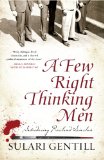
Sulari Gentill's 'Rowland Sinclair' series goes from strength to strength. She is such a refreshing new voice in Australian crime writing: no brutalized female corpses; barely a hint of sex; lots of solid historical background (and some wonderful bits from old newspapers), memorable characters, classic locations, and a sprinkling of little historical and literary riddling to tease the reader. I reviewed her first book (A Few Right Thinking Men) here, and have recently devoured the next three in the series. 


The second in the series is A Decline in Prophets. I was wondering how Gentill would manage her large cast of regular characters, and a highlight of this book was how she took her time to flesh out the groups' dynamics. Their witty badinage is a delight. We discover our hero Rowly - semi-voluntarily exiled from Australia after his disastrous run-in with the New Guard - travelling in style on RMS Aquitania, along with a group of Theosophists (including Annie Besant), a hot-headed Catholic Bishop, various eligible young ladies, and - of course - his faithful coterie of Clyde the artist, Milt the Red poet, and Edna, sculptress and unattainable love of Rowly's life. The action shifts - with murders aplenty - from the luxuries of life onboard to New York (where Edna makes a hit with one Archie Leach) then back to Sydney. Mysterious pregnancies, mad prophets, ambiguous suicides, Masons, mortuary chapels, dodgy poetry, and lots of fun and games. Can the gang make it safely back to lovely Woollahra with a murderer hot in pursuit? And has Rowly pushed his conservative elder brother's tolerance of his Bohemian lifestyle too far this time? A Decline in Prophets won the 2012 Davitt Award for Best Adult Crime Novel by an Australian woman.


The third in the series, Miles Off Course, is, I think (and at the moment!), my favourite. It has such a wonderful Australian setting, moving from the sophisticated high life of the rich in the Blue Mountains to the harsh life of the stockmen who graze their animals in the 'High Country' of the Snowy Mountains. Rowly is sent by his brother Wilfred (a 'Mycroft', and one of my favourite characters - perhaps I relate to being the oldest sibling?) to track down a missing stockman. Harry Simpson is no ordinary stockman - an Aboriginal hand who grew up with the Sinclairs, he is far more than an employee to the Sinclair men. Rowly's stint roughing it in the High Country is more than welcome to him for other reasons: someone is gunning for him - could he be the next high-rolling victim of a spate of abductions? If the travelling snake circus doesn't get him first… This book also has the single best opening line I have read in the last decade. 


No 4., Paving the New Road, offers a change of scene for Rowly and his mates; it is also rather more brutal than its predecessors. It is quite an achievement on Gentill's part to create a veristic 'What If?' as she transports her gang of Bohemian Australian artists to Munich, 1933: "it was decided that they would pose as art dealers. Art was a language they could all speak." Rowly agrees to go to Germany to sabotage the plans of his old enemy Eric Campbell, the New Guard politician who would bring Fascism to Australia. Campbell is touring with members of the British Union of Fascists, whose members include the repellent Unity Mitford (with whom Rowly makes rather a hit). Along the way, Rowly also makes the acquaintance of a young blonde lady called Eva who works for a photographer and has a very secret boyfriend… Gentill does a lovely job manipulating people, events (and dates) to place her hero at the centre of an Australian-led fight against Fascism. There's a lot of humour in this book, despite the grim subject-matter and the knowledge of what is to come for the world. Where will Rowly and co. be in 1939? At the rate Gentill is producing these books, that won't be long! (Two incidental points: does "taught-haired" = tow-haired? And how freaky is it to discover someone you know has given his name to a character. My equilibrium is still awry.) 

If you liked this... for crime-loving history-nerds? It is hard to avoid comparison with Kerry Greenwood's 1920s' heroine Phryne Fisher, who is rich, strong-minded, and (er... unlike Rowly) not always a lady.


Thursday, September 20, 2012

{misc.} learn to fly like biggles

I was sorting out some photos of my trip to the U.K., and this one made me laugh. It was in the window of The Haunted Bookshop in St Edward's Passage in Cambridge.  


The book is summarized here. W. E. Johns is given the rank F/O (Flying Officer) on the cover. The book dates from 1932, the year the first 'Biggles' book appeared (we've just missed the 80th anniversary of The Camels Are Coming). Johns published as "Captain", but never in fact held that rank. 

Tuesday, May 1, 2012

{review} miss buncle's book

D. E. Stevenson Miss Buncle's Book (1934 [2008]) 

   
Mr Abbott... had given up trying to predict the success or unsuccess of the novels he published, but he went on publishing them and hoping that each one published would prove itself a bestseller. Last Friday morning his nephew, Sam Abbott, who had just been taken into the firm of Abbott & Spicer, suddenly appeared in Mr Abbott's sanctum with a deplorable lack of ceremony, and announced 'Uncle Arthur, the feller who wrote this book is either a genius or an imbecile.' Something stirred in Mr Abbott's heart at these words, (a sort of sixth sense perhaps) and he had held out his hand for the untidy-looking manuscript with a feeling of excitement – was this the bestseller at last?
I'm going to confess up front that I read Miss Buncle's Book... on my Kindle. I know, I know: what about the tactile pleasures of a beautiful Persephone book in the hand? What of the terribleness of e-reading something with the actual word 'Book' on the cover, etc. etc.? I'm a bad person. But Persephone Books is now selling e-books, and one can only hope that this leads to an even wider audience for their lovely publications.

I am always a bit worried that I won't like a book that others love. For instance, I find myself in the tiny camp (I may even be camping by myself) of people who didn't like Miss Hargreaves and found I Capture the Castle twee and annoying. Fortunately, I loved Miss Buncle's Book: I loved the idea of the book within the book within the book, I loved the writing, and I just thought it was screwball comedy funny - like a wonderful B&W film of the 30s.

Without giving too much away, Miss Buncle writes a book based on what she knows. What she knows is, unfortunately for her future peace of mind, the inner workings of the small village in which she lives. Chronicles of an English Village (a.k.a. Disturbers of the Peace) becomes a bestseller and half the village is up in arms about who the anonymous author could be; and then strange things begin to happen amid the chaos... Miss Buncle - with her "unsophisticated palate and a good digestion"- we find, is a very fine student of human nature indeed:
She was obviously a simple sort of person – shabbily dressed in a coat and skirt of blue flannel. Her hat was dreadful, her face was pale and rather thin, with a pointed chin and a nondescript nose, but on the other hand her eyes were good – dark blue with long lashes – and they twinkled a little when she laughed. Her mouth was good too, and her teeth – if they were real – magnificent.
Miss Buncle is also my favourite type of heroine: as well as making her own way entirely on the merits of her own intelligence, she ticks another box - the heroine who whips off her spectacles (figuratively in this case), lets down her hair (OK, perms her hair), finds a good dressmaker and is instantly transformed into, if not a Siren, then certainly into her rather different alter-ego of the book.

I find this trope eerily irresistible. The Cinderella scene always gives me a primitive sort of pleasure even as I snort in derision at yet another manipulative canonical trope courtesy of the patriarchy: think of Miss Pettigrew transformed; or, the companion in Agatha Christie's The Mystery of the Blue Train or the young tomboy in another favourite Christie, The Moving Finger, or, indeed, Eliza Doolittle.

I've heard (My Porch) that the sequel (Miss Buncle Married) isn't as good, so I'm just going to leave this one in my mind for a bit.
'How nice for you – and for her of course,' exclaimed Barbara. She had lived for so long amongst these people and had suffered so many afternoon teas that she was able to say the expected thing without thinking about it at all. You simply put a penny in the machine and the expected thing came out at once, all done up in a neat little packet, and suitably labelled. The machine worked without any effort on Barbara's part, it even worked when the real Barbara was absent and only the shell, dressed in its shabby garments, remained sitting upright upon its chair. The real Barbara often flew away like that and took refuge from the dullness and boredom of Silverstream in the scintillating atmosphere of Copperfield.
Did Stevenson write anything else I should read?

Rating: 10/10.

If you liked this: my favourite examples of the Cinderella transformation are above.

{READ IN 2018}

  • FEBRUARY
  • 30.
  • 29.
  • 28.
  • 27.
  • 26. The Grave's a Fine & Private Place - Alan Bradley
  • 25. This is What Happened - Mick Herron
  • 24. London Rules - Mick Herron
  • 23. The Third Eye - Ethel Lina White
  • 22. Thrice the Brindled Cat Hath Mewed - Alan Bradley
  • 21. As Chimney Sweepers Come to Dust - Alan Bradley
  • 20. The Dead in Their Vaulted Arches - Alan Bradley
  • 19. Speaking from Among the Bones - Alan Bradley
  • JANUARY
  • 18. Eleanor Oliphant is Completely Fine - Gail Honeyman
  • 17. Miss Ranskill Comes Home - Barbara Euphan Todd
  • 16. The Long Arm of the Law - Martin Edwards (ed.)
  • 15. Nobody Walks - Mick Herron
  • 14. The Talented Mr Ripley - Patricia Highsmith
  • 13. Portrait of a Murderer - Anthony Gilbert
  • 12. Murder is a Waiting Game - Anthony Gilbert
  • 11. Tenant for the Tomb - Anthony Gilbert
  • 10. Death Wears a Mask - Anthony Gilbert
  • 9. Night Encounter - Anthony Gilbert
  • 8. The Visitor - Anthony Gilbert
  • 7. The Looking Glass Murder - Anthony Gilbert
  • 6. The Voice - Anthony Gilbert
  • 5. The Fingerprint - Anthony Gilbert
  • 4. Ring for a Noose - Anthony Gilbert
  • 3. No Dust in the Attic - Anthony Gilbert
  • 2. Uncertain Death - Anthony Gilbert
  • 1. She Shall Died - Anthony Gilbert

{READ IN 2017}

  • DECEMBER
  • 134. Third Crime Lucky - Anthony Gilbert
  • 133. Death Takes a Wife - Anthony Gilbert
  • 132. Death Against the Clock - Anthony Gilbert
  • 131. Give Death a Name - Anthony Gilbert
  • 130. Riddle of a Lady - Anthony Gilbert
  • 129. And Death Came Too - Anthony Gilbert
  • 128. Snake in the Grass - Anthony Gilbert
  • 127. Footsteps Behind Me - Anthony Gilbert
  • 126. Miss Pinnegar Disappears - Anthony Gilbert
  • 125. Lady-Killer - Anthony Gilbert
  • 124. A Nice Cup of Tea - Anthony Gilbert
  • 123. Die in the Dark - Anthony Gilbert
  • 122. Death in the Wrong Room - Anthony Gilbert
  • 121. The Spinster's Secret - Anthony Gilbert
  • 120. Lift up the Lid - Anthony Gilbert
  • 119. Don't Open the Door - Anthony Gilbert
  • 118. The Black Stage - Anthony Gilbert
  • 117. A Spy for Mr Crook - Anthony Gilbert
  • 116. The Scarlet Button - Anthony Gilbert
  • 115. He Came by Night - Anthony Gilbert
  • 114. Something Nasty in the Woodshed - Anthony Gilbert
  • NOVEMBER
  • 113. Death in the Blackout - Anthony Gilbert
  • 112. The Woman in Red - Anthony Gilbert
  • 111. The Vanishing Corpse - Anthony Gilbert
  • 110. London Crimes - Martin Edwards (ed.)
  • 109. The Midnight Line - Anthony Gilbert
  • 108. The Clock in the Hatbox - Anthony Gilbert
  • 107. Dear Dead Woman - Anthony Gilbert
  • 106. The Bell of Death - Anthony Gilbert
  • 105. Treason in my Breast - Anthony Gilbert
  • 104. Murder has no Tongue - Anthony Gilbert
  • 103. The Man who Wasn't There - Anthony Gilbert
  • OCTOBER
  • 102. Murder by Experts - Anthony Gilbert
  • 101. The Perfect Murder Case - Christopher Bush
  • 100. The Plumley Inheritance - Christopher Bush
  • 99. Spy - Bernard Newman
  • 98. Cargo of Eagles - Margery Allingham & Philip Youngman Carter
  • 97. The Mind Readers - Margery Allingham
  • SEPTEMBER
  • 96. The China Governess - Margery Allingham
  • 95. Hide My Eyes - Margery Allingham
  • 94. The Beckoning Lady - Margery Allingham
  • 93. The Tiger in the Smoke - Margery Allingham
  • 92. More Work for the Undertaker - Margery Allingham
  • 91. Coroner's Pidgin - Margery Allingham
  • 90. Traitor's Purse - Margery Allingham
  • 89. The Fashion in Shrouds - Margery Allingham
  • 88. The Case of the Late Pig - Margery Allingham
  • 87. Dancers in Mourning - Margery Allingham
  • AUGUST
  • 86. Flowers for the Judge - Margery Allingham
  • 85. Death of a Ghost - Margery Allingham
  • 84. Sweet Danger - Margery Allingham
  • 83. Police at the Funeral - Margery Allingham
  • 82. Look to the Lady - Margery Allingham
  • 81. Mystery Mile - Margery Allingham
  • 80. The Crime at Black Dudley - Margery Allingham
  • 79. The White Cottage Mystery - Margery Allingham
  • 78. Murder Underground - Mavis Doriel Hay
  • 77. No Man's Land - David Baldacci
  • 76. The Escape - David Baldacci
  • 75. The Forgotten - David Baldacci
  • 74. Zero Day - David Baldacci
  • JULY
  • 73. Pilgrim's Rest - Patricia Wentworth
  • 72. The Case is Closed - Patricia Wentworth
  • 71. The Watersplash - Patricia Wentworth
  • 70. Lonesome Road - Patricia Wentworth
  • 69. The Listening Eye - Patricia Wentworth
  • 68. Through the Wall - Patricia Wentworth
  • 67. Out of the Past - Patricia Wentworth
  • 66. Mistress - Amanda Quick
  • 65. The Black Widow - Daniel Silva
  • 64. The Narrow - Michael Connelly
  • 63. The Poet - Michael Connelly
  • 62. The Visitor - Lee Child
  • 61. No Middle Name: The Complete Collected Jack Reacher Stories - Lee Child
  • JUNE
  • 60. The Queen's Accomplice - Susan Elia MacNeal
  • 59. Mrs Roosevelt's Confidante - Susan Elia MacNeal
  • 58. The PM's Secret Agent - Susan Elia MacNeal
  • 57. His Majesty's Hope - Susan Elia MacNeal
  • 56. Princess Elizabeth's Spy - Susan Elia MacNeal
  • 55. Mr Churchill's Secretary - Susan Elia MacNeal
  • 54. A Lesson in Secrets - Jacqueline Winspear
  • 53. Hit & Run - Lawrence Block
  • 52. Hit Parade - Lawrence Block
  • 51. Hit List - Lawrence Block
  • 50. Six Were Present - E. R. Punshon
  • 49. Triple Quest - E. R. Punshon
  • MAY
  • 48. Dark is the Clue - E. R. Punshon
  • 47. Brought to Light - E. R. Punshon
  • 46. Strange Ending - E. R. Punshon
  • 45. The Attending Truth - E. R. Punshon
  • 44. The Golden Dagger - E. R. Punshon
  • 43. The Secret Search - E. R. Punshon
  • 42. Spook Street - Mick Herron
  • 41. Real Tigers - Mick Herron
  • 40. Dead Lions - Mick Herron
  • 39. Slow Horses - Mick Herron
  • APRIL
  • 38. Everybody Always Tells - E. R. Punshon
  • 37. So Many Doors - E. R. Punshon
  • 36. The Girl with All the Gifts - M. R. Carey
  • 35. A Scream in Soho - John G. Brandon
  • 34. A Murder is Arranged - Basil Thomson
  • 33. The Milliner's Hat Mystery - Basil Thomson
  • 32. Who Killed Stella Pomeroy? - Basil Thomson
  • 31. The Dartmoor Enigma - Basil Thomson
  • 30. The Case of the Dead Diplomat - Basil Thomson
  • 29. The Case of Naomi Clynes - Basil Thomson
  • 28. Richardson Scores Again - Basil Thomson
  • 27. A Deadly Thaw - Sarah Ward
  • MARCH
  • 26. The Spy Paramount - E. Phillips Oppenheim
  • 25. The Great Impersonation - E. Phillips Oppenheim
  • 24. Ragdoll - Daniel Cole
  • 23. The Case of Sir Adam Braid - Molly Thynne
  • 22. The Ministry of Fear - Graham Greene
  • 21. The Draycott Murder Mystery - Molly Thynne
  • 20. The Murder on the Enriqueta - Molly Thynne
  • 19. The Nowhere Man - Gregg Hurwitz
  • 18. He Dies and Makes No Sign - Molly Thynne
  • FEBRUARY
  • 17. Death in the Dentist's Chair - Molly Thynne
  • 16. The Crime at the 'Noah's Ark' - Molly Thynne
  • 15. Harriet the Spy - Louise Fitzhugh
  • 14. Night School - Lee Child
  • 13. The Dancing Bear - Frances Faviell
  • 12. The Reluctant Cannibals - Ian Flitcroft
  • 11. Fear Stalks the Village - Ethel Lina White
  • 10. The Plot - Irving Wallace
  • JANUARY
  • 9. Understood Betsy - Dorothy Canfield Fisher
  • 8. Give the Devil his Due - Sulari Gentill
  • 7. A Murder Unmentioned - Sulari Gentill
  • 6. Dead Until Dark - Charlaine Harris
  • 5. Gentlemen Formerly Dressed - Sulari Gentill
  • 4. While She Sleeps - Ethel Lina White
  • 3. A Chelsea Concerto - Frances Faviell
  • 2. Kipps: The Story of a Simple Soul - H. G. Wells
  • 1. Heft - Liz Moore
Free Delivery on all Books at the Book Depository