Showing posts with label oscar wilde. Show all posts

Monday, August 1, 2011

{review} constance: the tragic and scandalous life of mrs oscar wilde

Franny Moyle Constance: The Tragic and Scandalous Life of Mrs Oscar Wilde (2011)

Constance: The Tragic and Scandalous Life of Mrs Oscar Wilde

‘My dearest Otho,’ his sister announced, ‘Prepare yourself for an astounding piece of news! I am engaged to Oscar Wilde and perfectly and insanely happy.’
Poor Constance Wilde. This book made me very angry with Oscar Wilde. I don't think that I had fully perceived the amount of damage that his sensational fall from grace had done to anyone apart from himself.
Every day that I see you, every moment that you are with me I worship you more, my whole life is yours to do as you will with it, such a poor gift to offer up to you, but yet all I have and so you will not despise it.
Franny Moyle has written a most interesting book about the woman who married Oscar Wilde. In a sense it is also an interesting book because it reveals how little remains of a Victorian woman's life unless it is recorded contemporaneously with that life. Constance, we find, has been almost entirely historically subsumed within the life of her famous husband. Perhaps, too, the 'cult' of Oscar Wilde has pushed her into a lesser position? And, further, owing to the loss of many of her letters and possessions (for example, when the Wilde household was sold off to pay his creditors), there are some very patchy areas of her life which require an imaginative leap towards reconstruction.

Moyle has done a good job of filling in the blanks. Her Constance is a woman of letters, a clever translator, a contributor to her husband's work, a feminist, a political animal, an avid interpreter of Aestheticism in art and design, a fashionista (and early advocate of 'rational dress' who "used fashion to convey something of her political, feminist leanings") and a woman of intense religious feeling. She was also 5'8" (I love that detail).

When they became engaged,
Oscar was just as infatuated with her as she was with him, a fact revealed in Oscar’s letter to his friend Lillie Langtry. ‘I am going to be married to a beautiful girl called Constance Lloyd,’ he wrote, a grave, slight, violet-eyed Artemis, with great coils of heavy brown hair which make her flower-like head droop like a flower, and wonderful ivory hands which draw music from the piano so sweet that the birds stop singing to listen to her.
What happened? It is possible to make some assumptions in the broadest terms: Constance's second pregnancy was very difficult; and Oscar had always enjoyed spending time apart from his wife anyway. And then there was the increasing recognition of his sexual preference for men.
The journalist and author Frank Harris, a friend of Wilde’s, claimed that years later Oscar recounted to him how during this period his sexual attraction to Constance plummeted: When I married, my wife was a beautiful girl, white and slim as a lily, with dancing eyes and gay rippling laughter like music. In a year or so the flower-like grace had all vanished; she became heavy, shapeless, deformed: she dragged herself around the house in uncouth misery with drawn blotched face and hideous body, sick at heart because of our love. It was dreadful. I tried to be kind to her; forced myself to touch and kiss her; but she was sick always, and – oh! I cannot recall it, it is all loathsome.
There were constant worries with money; with the children; with Constance's health (Moyle makes a valiant attempt to figure out what was wrong with Constance; unsurprisingly, given the lack of information, it was likely something gynaecological); with Oscar's absences; with his friendships with young men as he strove to fill that ‘secret sacred niche’ [urgh! What a phrase…]. Yet they managed to hold things together:
On the surface they were fine. Yeats, who joined the Wildes on Christmas Day in 1888, described Oscar’s life in Tite Street as a ‘perfect harmony … with his beautiful wife and two young children’. And yet Yeats, with terrific perception, added that his home life ‘suggested some deliberate artistic composition’.

Constance with her eldest son Cyril, 1889 (Source)

Constance filled her life with activities. She was a keen supporter of clubs where unaccompanied women could dine without critical comment. Her other interests were political, such as the Rational Dress Society and the Women's Liberation Federation (to whom she gave papers on Irish Home Rule and other international issues):
‘I was astonished and delighted to notice yesterday … how very much Mrs Oscar Wilde has improved in public speaking,’ one critic noted after a WLF event. ‘She was always graceful and always charming, but now there is an earnestness and an ease about her which is the result of practice in platform speaking, and I shall not be surprised if in a few years Mrs Wilde has become one of the most popular among “platform ladies”.'
It seems that she also turned to religion and the occult (Theosophy was a popular pastime for Victorian men and women), becoming a member of the Isis-Urania Temple of the Hermetic Order of the Golden Dawn (amusingly, "[p]rospective members… could apply via the offices of the Sanitary Wood Wool Company in Holborn"). The Latin name she chose to assume in the Temple was, tellingly, 'Qui Patitur Vincit' - 'Who Endures Wins' and her course of study for the Temple involved learning Hebrew.

Her tolerance for Oscar's young male friends was extraordinary; it is difficult to determine how much she understood about what was going on around her, literally in her own home.
‘Having got all our rooms quite full yesterday a telegram comes from Lord Alfred Douglas asking to be put up for a night! I don’t believe that even you have to contrive to put 7 people into 6 rooms. However, fortunately he put it off till to-day, and I think we can manage.’41 The day after Bosie arrived, Constance had to return Cyril to Hunstanton. When she got back to Cromer, she discovered that, far from staying for just a day, Bosie had installed himself for the duration. She didn’t mind too much. The daily golf sessions Oscar began enjoying with Bosie were a source of amusement for her rather than concern. ‘I am becoming what I am told the wives of golfers are called a “golf-widow”,’ she quite happily related...
It is with Bosie, of course, that it all goes off the rails. It has always astounded me that, even after his prison time, Wilde was unable to resist Bosie, 'a friendship that was entirely destructive of everything fine in me either from the intellectual or ethical point of view' (1893). Constance's unhappiness about Bosie's influence leads her, in turn, to look outside her increasingly fraught marriage for support and love. There are hints that she fell in love with Arthur Humphreys (general manager of Hatchard's), with whom she was editing some of Oscar's works. But then the great scandal broke, Wilde was sentenced to jail, the Wilde house was broken up for the creditors, and Constance was forced to flee overseas with the two children to escape the scandal. As one of her few remaining friends, Lady Georgina Mount-Temple wrote to her daughter,
‘I do not think there could be a greater trial with such disgusting shame … one cannot bear even to allude to it... Can one touch pitch and not be defiled? You are quite right in keeping aloof – so would I if I did not feel called upon to shelter her.’
And that's a friend!

The final years of Constance's life were a misery. Exiled from England by the scandal, she continued to face constant battles with money, and with Oscar's friends who wished to interfere with their putative divorce and financial settlements (astonishingly, Constance continued to provide funds to her husband). There was the indignity of his taking up with Bosie again - and breaching the conditions under which she was providing an allowance. And there was her continued ill-health, which led to her decision to undergo what proved to be a fatal surgical procedure. Constance was only 40 when she died, on the 7th of April 1898. She is buried in Genoa.

Moyle's biography is a well-researched and sensitive reclamation of her subject's life. I thoroughly enjoyed reading it. So that you can become nicely irate about poor Constance Wilde, I leave you with Bosie's comment on her death:
‘As to his wife,’ Bosie said, ‘he married her for love and if she had treated him properly and stuck to him after he had been in prison, as a really good wife would have done, he would have gone on loving her to the end of his life … Obviously she suffered a great deal and deserves every sympathy, but she fell woefully short of the height to which she might have risen.’
Ouch.

Rating: 9/10.

If you liked this... I'm in the mood to loath Wilde after this book, but he's still a genius. Perhaps I ought to go back and try to read between the lines of An Ideal Husband...

Wednesday, February 23, 2011

{review} flowers of unnatural hue

Robert Hichens The Green Carnation (1894)
"I heard a bon mot of yours at the Foreign Office last night.
"Indeed. What was it?" 
"Er--really I--oh! it was something about life, you know, with a sort of general application, one of your best."

The Green Carnation (Dodo Press)

I thought I should read something appropriate while following Oscar Wilde Week at Esoteric London last week.
"These strawberries are very good," he said. "I should finish them, only I hate finishing anything. There is something so commonplace about it. Don't you think so? Commonplace people are always finishing off things, and getting through things. They map out their days, and have special hours for everything. I should like to have special hours for nothing. That would be much more original."
The Green Carnation ("the arsenic flower of an exquisite life") is notorious for cementing Oscar Wilde's fall from grace. Hichens was well acquainted with the circle around Wilde. His satirical take on these late nineteenth century 'Moderns' is pitch-perfect. This is a very funny book if you can forget the terrible aftermath. It is wall-to-wall Wilde-styled nonsensicality; indeed "the art of preposterous conversation" often reads just like Wilde. The effect of this overload of overstyled observations on the most banal topics - along with sweepingly illogical twists on the  Wildean 'habit' of contradiction and unconventionality and originality - serves to render Wildeism ridiculous.
"How curious," said Mr. Amarinth, taking a bun delicately between his plump white fingers. "My temper and my heart are the only two things I never lose! Everything else vanishes. I think the art of losing things is a very subtle art. So few people can lose anything really beautifully. Anybody can find a thing. That is so simple. A crossing sweeper can discover a sixpence lying in the road. It is the crossing sweeper who loses a sixpence who shows real originality."
Wilde is referred to in the text by name ("I shall go and lie down and read Oscar Wilde's 'Decay of Lying.' That always sends me to sleep. It is like himself, all artfulness and no art.") but he is represented in the satire by one Esmé Amarinth ("I was born epigrammatic, and my dying remark will be a paradox") who is inseparable from Lord Reggie Hastings (i.e. Lord Alfred Douglas). It is Lord Reggie's role as an inferior copy of the dazzling original which enables the text to poke its best jabs at the Wilde phenomenon:
Reggie Hastings, at least, was not ashamed. The mantel-piece in his sitting-room bore only photographs of himself, and he explained this fact to inquirers by saying that he worshipped beauty. Reggie was very frank. When he could not be witty, he often told the naked truth; and truth, without any clothes on, frequently passes for epigram. It is daring, and so it seems clever.
Lord Reggie and Esmé go to Surrey for a week of carefully contrived rusticity with the London hostess Mrs. Windsor ("Ah! here is our Bovril! I feel so delightfully vicious when I drink it, so unconventional!"), the theatrical Madame Valtesi ("I always hate to see people drinking when I have finished. It makes me feel like a barmaid.") and the young and highly conventional widow Lady Locke who may or may not marry Lord Reggie:
"What do you think about it, Reggie?" Amarinth said, as they began to discuss their oysters. "Could you commit the madness of matrimony with Lady Locke? You are so wonderful as you are, so complete in yourself, that I scarcely dare to wish it, or anything else for you: and you live so comfortably upon debts, that it might be unwise to risk the possible discomfort of having money.
Lady Locke soons discovers that the handsome Lord Reggie is appallingly self-obsessed and shallow. But is he also wicked?
She still fancied that Lord Reggie was nothing more than a whimsical poseur, bitten by the tarantula of imitation that preys upon weak natures.
But further events leave her unconvinced:
"But do you really object to the green carnation?"
"That depends. Is it a badge?"
"How do you mean?"
"I only saw about a dozen in the Opera House to-night, and all the men who wore them looked the same. They had the same walk, or rather waggle, the same coyly conscious expression, the same wavy motion of the head. When they spoke to each other, they called each other by Christian names. Is it a badge of some club or some society, and is Mr. Amarinth their high priest? They all spoke to him, and seemed to revolve round him like satellites around the sun."
"My dear Emily, it is not a badge at all. They wear it merely to be original."
"And can they only be original in a buttonhole way? Poor fellows."
"You don't understand. They like to draw attention to themselves."
"By their dress? I thought that was the prerogative of women."
"Really, Emily, you are colonial..."
She declines Sir Reggie's proposal ("Esmé said to-day that marriage was a brilliant absurdity. Will you be brilliantly absurd? Will you marry me?"):
It seems to me that Mr. Amarinth has created a cult. Let me call it the cult of the green carnation. I suppose it may be called modern. To me it seems very silly and rather wicked. If you would take that hideous green flower out of your coat, not because I asked you to, but because you hated it honestly, I might answer your question differently. If you could forget what you call art, if you could see life at all with a straight, untrammelled vision, if you could be like a man, instead of like nothing at all in heaven or earth except that dyed flower, I might perhaps care for you in the right way. But your mind is artificially coloured: it comes from the dyer's. It is a green carnation; and I want a natural blossom to wear in my heart."
Masses of epigrams on the commonplace are all marked by the simplistic opposing of whatever society values: "We make vices of our virtues, and virtues of our vices. The former we consider the duty that we owe to others, the latter the duty that we owe to ourselves." 

The text also takes some jabs at the issue of whether Wilde's epigrams were indeed original or borrowed from other languages. 

The Londoners escape to rusticity is as much a fraud as their utterances: "She rustled away with weary grace, rattling delicately a large bunch of keys that didn't open any thing in particular. They were a part of her get up as a country hostess." Everything is a vast fraud:
"That sky is becoming so terribly imitative that I can hardly go on. Why are modern sunsets so intolerably true to Turner?"
[Reggie] was holding up a table-spoon filled with marmalade to catch the light from a stray sunbeam that filtered in through the drawn blinds, and wore a rapt look, a "caught up" look, as Mrs. Windsor would have expressed it. "Good morning," he said softly. "Is not this marmalade Godlike? This marvellous, clear, amber glow, amber with a touch of red in it, almost makes me believe in an after life. Surely, surely marmalade can never die!" "I must have been mistaken," Mrs. Windsor thought, as she expressed her sense of the eternity of jams in general in suitable language.
As I said, a very funny book.

I read The Green Carnation for 99 cents on my Kindle but it is available all over the place for free (e.g., Gutenberg) Incidentally, I didn't realise that Robert Hichens wrote The Paradine Case (1933) on which was based the Gregory Peck movie of the same name (1947).

Rating: 9/10

If you liked this... read the real thing. Oscar Wilde.

Thursday, August 19, 2010

{wishlist}

Begging to join the groaning shelves this week:

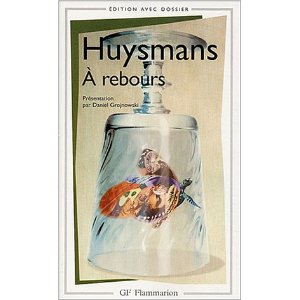
 Against Nature: A Rebours (Oxford World's Classics)

Joris-Karl Huysmans (1884):

Sometimes (hence 'book-forgetting') I've wanted to read something for so long that I can't remember why I added it to the wishlist in the first place. I have a French copy of À Rebours which I bought as a souvenir at the Musée Gustave Moreau in Paris; but that's far too hard work and it just sits on the shelf mocking my good intentions.


I think my interest was probably sparked via something Oscar Wilde-related. À Rebours was a book of profound importance to Wilde: "This last book of Huysmans is one of the best I have ever seen" [quoted in Richard Ellmann Oscar Wilde, p.237 in my Penguin 1988 copy].

 Oscar Wilde

In Richard Davenport-Hines' A Night at the Majestic: Proust & the Great Modernist Dinner Party of 1922 (2006), Huysmans' name is mispelled Huysman throughout. I hope that's not the only reason for my interest. Unfortunately, once I've found one glaring typo I tend to lose some readerly confidence. Davenport-Hines takes a single incident - a dinner party (admittedly one involving Proust, Stravinsky, Picasso, Joyce and Diaghilev!) - and spirals out in all directions, digging up loads of fascinating details. It is a worthwhile read but a bit like a biographic form of attention deficit hyperactivity disorder.


Hopefully when I finally read À Rebours I will remember why I wanted to do so. At least that's sort of Proustian...

Saturday, July 3, 2010

{weekend words}

I don't play accurately - any one can play accurately - but I play with wonderful expression. As far as the piano is concerned, sentiment is my forte. I keep science for Life.
Algernon in Oscar Wilde's The Importance of Being Earnest (1895), Act I.

{READ IN 2018}

  • FEBRUARY
  • 30.
  • 29.
  • 28.
  • 27.
  • 26. The Grave's a Fine & Private Place - Alan Bradley
  • 25. This is What Happened - Mick Herron
  • 24. London Rules - Mick Herron
  • 23. The Third Eye - Ethel Lina White
  • 22. Thrice the Brindled Cat Hath Mewed - Alan Bradley
  • 21. As Chimney Sweepers Come to Dust - Alan Bradley
  • 20. The Dead in Their Vaulted Arches - Alan Bradley
  • 19. Speaking from Among the Bones - Alan Bradley
  • JANUARY
  • 18. Eleanor Oliphant is Completely Fine - Gail Honeyman
  • 17. Miss Ranskill Comes Home - Barbara Euphan Todd
  • 16. The Long Arm of the Law - Martin Edwards (ed.)
  • 15. Nobody Walks - Mick Herron
  • 14. The Talented Mr Ripley - Patricia Highsmith
  • 13. Portrait of a Murderer - Anthony Gilbert
  • 12. Murder is a Waiting Game - Anthony Gilbert
  • 11. Tenant for the Tomb - Anthony Gilbert
  • 10. Death Wears a Mask - Anthony Gilbert
  • 9. Night Encounter - Anthony Gilbert
  • 8. The Visitor - Anthony Gilbert
  • 7. The Looking Glass Murder - Anthony Gilbert
  • 6. The Voice - Anthony Gilbert
  • 5. The Fingerprint - Anthony Gilbert
  • 4. Ring for a Noose - Anthony Gilbert
  • 3. No Dust in the Attic - Anthony Gilbert
  • 2. Uncertain Death - Anthony Gilbert
  • 1. She Shall Died - Anthony Gilbert

{READ IN 2017}

  • DECEMBER
  • 134. Third Crime Lucky - Anthony Gilbert
  • 133. Death Takes a Wife - Anthony Gilbert
  • 132. Death Against the Clock - Anthony Gilbert
  • 131. Give Death a Name - Anthony Gilbert
  • 130. Riddle of a Lady - Anthony Gilbert
  • 129. And Death Came Too - Anthony Gilbert
  • 128. Snake in the Grass - Anthony Gilbert
  • 127. Footsteps Behind Me - Anthony Gilbert
  • 126. Miss Pinnegar Disappears - Anthony Gilbert
  • 125. Lady-Killer - Anthony Gilbert
  • 124. A Nice Cup of Tea - Anthony Gilbert
  • 123. Die in the Dark - Anthony Gilbert
  • 122. Death in the Wrong Room - Anthony Gilbert
  • 121. The Spinster's Secret - Anthony Gilbert
  • 120. Lift up the Lid - Anthony Gilbert
  • 119. Don't Open the Door - Anthony Gilbert
  • 118. The Black Stage - Anthony Gilbert
  • 117. A Spy for Mr Crook - Anthony Gilbert
  • 116. The Scarlet Button - Anthony Gilbert
  • 115. He Came by Night - Anthony Gilbert
  • 114. Something Nasty in the Woodshed - Anthony Gilbert
  • NOVEMBER
  • 113. Death in the Blackout - Anthony Gilbert
  • 112. The Woman in Red - Anthony Gilbert
  • 111. The Vanishing Corpse - Anthony Gilbert
  • 110. London Crimes - Martin Edwards (ed.)
  • 109. The Midnight Line - Anthony Gilbert
  • 108. The Clock in the Hatbox - Anthony Gilbert
  • 107. Dear Dead Woman - Anthony Gilbert
  • 106. The Bell of Death - Anthony Gilbert
  • 105. Treason in my Breast - Anthony Gilbert
  • 104. Murder has no Tongue - Anthony Gilbert
  • 103. The Man who Wasn't There - Anthony Gilbert
  • OCTOBER
  • 102. Murder by Experts - Anthony Gilbert
  • 101. The Perfect Murder Case - Christopher Bush
  • 100. The Plumley Inheritance - Christopher Bush
  • 99. Spy - Bernard Newman
  • 98. Cargo of Eagles - Margery Allingham & Philip Youngman Carter
  • 97. The Mind Readers - Margery Allingham
  • SEPTEMBER
  • 96. The China Governess - Margery Allingham
  • 95. Hide My Eyes - Margery Allingham
  • 94. The Beckoning Lady - Margery Allingham
  • 93. The Tiger in the Smoke - Margery Allingham
  • 92. More Work for the Undertaker - Margery Allingham
  • 91. Coroner's Pidgin - Margery Allingham
  • 90. Traitor's Purse - Margery Allingham
  • 89. The Fashion in Shrouds - Margery Allingham
  • 88. The Case of the Late Pig - Margery Allingham
  • 87. Dancers in Mourning - Margery Allingham
  • AUGUST
  • 86. Flowers for the Judge - Margery Allingham
  • 85. Death of a Ghost - Margery Allingham
  • 84. Sweet Danger - Margery Allingham
  • 83. Police at the Funeral - Margery Allingham
  • 82. Look to the Lady - Margery Allingham
  • 81. Mystery Mile - Margery Allingham
  • 80. The Crime at Black Dudley - Margery Allingham
  • 79. The White Cottage Mystery - Margery Allingham
  • 78. Murder Underground - Mavis Doriel Hay
  • 77. No Man's Land - David Baldacci
  • 76. The Escape - David Baldacci
  • 75. The Forgotten - David Baldacci
  • 74. Zero Day - David Baldacci
  • JULY
  • 73. Pilgrim's Rest - Patricia Wentworth
  • 72. The Case is Closed - Patricia Wentworth
  • 71. The Watersplash - Patricia Wentworth
  • 70. Lonesome Road - Patricia Wentworth
  • 69. The Listening Eye - Patricia Wentworth
  • 68. Through the Wall - Patricia Wentworth
  • 67. Out of the Past - Patricia Wentworth
  • 66. Mistress - Amanda Quick
  • 65. The Black Widow - Daniel Silva
  • 64. The Narrow - Michael Connelly
  • 63. The Poet - Michael Connelly
  • 62. The Visitor - Lee Child
  • 61. No Middle Name: The Complete Collected Jack Reacher Stories - Lee Child
  • JUNE
  • 60. The Queen's Accomplice - Susan Elia MacNeal
  • 59. Mrs Roosevelt's Confidante - Susan Elia MacNeal
  • 58. The PM's Secret Agent - Susan Elia MacNeal
  • 57. His Majesty's Hope - Susan Elia MacNeal
  • 56. Princess Elizabeth's Spy - Susan Elia MacNeal
  • 55. Mr Churchill's Secretary - Susan Elia MacNeal
  • 54. A Lesson in Secrets - Jacqueline Winspear
  • 53. Hit & Run - Lawrence Block
  • 52. Hit Parade - Lawrence Block
  • 51. Hit List - Lawrence Block
  • 50. Six Were Present - E. R. Punshon
  • 49. Triple Quest - E. R. Punshon
  • MAY
  • 48. Dark is the Clue - E. R. Punshon
  • 47. Brought to Light - E. R. Punshon
  • 46. Strange Ending - E. R. Punshon
  • 45. The Attending Truth - E. R. Punshon
  • 44. The Golden Dagger - E. R. Punshon
  • 43. The Secret Search - E. R. Punshon
  • 42. Spook Street - Mick Herron
  • 41. Real Tigers - Mick Herron
  • 40. Dead Lions - Mick Herron
  • 39. Slow Horses - Mick Herron
  • APRIL
  • 38. Everybody Always Tells - E. R. Punshon
  • 37. So Many Doors - E. R. Punshon
  • 36. The Girl with All the Gifts - M. R. Carey
  • 35. A Scream in Soho - John G. Brandon
  • 34. A Murder is Arranged - Basil Thomson
  • 33. The Milliner's Hat Mystery - Basil Thomson
  • 32. Who Killed Stella Pomeroy? - Basil Thomson
  • 31. The Dartmoor Enigma - Basil Thomson
  • 30. The Case of the Dead Diplomat - Basil Thomson
  • 29. The Case of Naomi Clynes - Basil Thomson
  • 28. Richardson Scores Again - Basil Thomson
  • 27. A Deadly Thaw - Sarah Ward
  • MARCH
  • 26. The Spy Paramount - E. Phillips Oppenheim
  • 25. The Great Impersonation - E. Phillips Oppenheim
  • 24. Ragdoll - Daniel Cole
  • 23. The Case of Sir Adam Braid - Molly Thynne
  • 22. The Ministry of Fear - Graham Greene
  • 21. The Draycott Murder Mystery - Molly Thynne
  • 20. The Murder on the Enriqueta - Molly Thynne
  • 19. The Nowhere Man - Gregg Hurwitz
  • 18. He Dies and Makes No Sign - Molly Thynne
  • FEBRUARY
  • 17. Death in the Dentist's Chair - Molly Thynne
  • 16. The Crime at the 'Noah's Ark' - Molly Thynne
  • 15. Harriet the Spy - Louise Fitzhugh
  • 14. Night School - Lee Child
  • 13. The Dancing Bear - Frances Faviell
  • 12. The Reluctant Cannibals - Ian Flitcroft
  • 11. Fear Stalks the Village - Ethel Lina White
  • 10. The Plot - Irving Wallace
  • JANUARY
  • 9. Understood Betsy - Dorothy Canfield Fisher
  • 8. Give the Devil his Due - Sulari Gentill
  • 7. A Murder Unmentioned - Sulari Gentill
  • 6. Dead Until Dark - Charlaine Harris
  • 5. Gentlemen Formerly Dressed - Sulari Gentill
  • 4. While She Sleeps - Ethel Lina White
  • 3. A Chelsea Concerto - Frances Faviell
  • 2. Kipps: The Story of a Simple Soul - H. G. Wells
  • 1. Heft - Liz Moore
Free Delivery on all Books at the Book Depository