Showing posts with label food. Show all posts

Tuesday, July 29, 2014

{housekeeping}

Yes, yes, slackest blogger IN THE WORLD.

Time for some housekeeping:

(Nancy's terrible tap-dancing summons a 50 foot demonic cat. Only kidding.)

  • I've just read 48 Nancy Drew books in a row. I think there is probably a future blog post in there somewhere. There are a scant handful of references to pineapples in these books, so I think you'll escape more pineapples for a bit. But isn't that a great cover?


  • I've put together a post of pictures for Paris in July over on my other blog skiourophilia. Hint: Paris is actually a synonym for "cake" in my world.

  • I'm adding this book to my informal "Wow, who thought that was a good name for a book?" list.


  • Even though I am the slackest blogger in the world, this has not stopped me starting another blog where I can collect all the lovely quotations about food and eating from the books I read and which I would otherwise forget: so, introducing reading feeding.


  • I feel a particularly naughty blogger as I was given such a nice surprise by Barb of the oh-so-tempting-I-want-to-read-everything-she-reads-and-am-so-a-stalker leaves and pages blog, who has nominated me for the Very Inspiring Blogger Award. Thank you very much Barb! The rules are:
Thank and link to the person who nominated you.
List the rules and display the award.
Share seven facts about yourself.
Nominate 15 other amazing blogs and comment on their posts
 to let them know they have been nominated.
Optional: display the award logo on your blog 
and follow the blogger who nominated you.

So, SEVEN FACTS:

1. So far this year I have bought 10 egg coddlers on ebay. I may have a problem. But I can stop anytime... maybe at 12? 


2. I love Arnold Schwarzenegger films.


3. I can whistle really well. Tunefully. Annoyingly. Painfully. Endlessly.


4. Related to 3., all cats have a song of their own to which they will respond. I agree that this may not necessary be a fact, but I have (fact) spent a lot of time testing this theory. George [left] adores 'Hey, Big Spender'. I think I've finally nailed Roger [right] down to the William Tell overture. I wonder what the neighbours think?


5. I live with these two cats.


6. I enjoy eating in posh restaurants by myself. It's like a naughty secret enjoyment. (I love to share a great food experience too. I'm not weird, just comfortable with my own company. And single.) Sometimes it actually helps not to have anyone's eye to catch when your amuse-bouche is served in a cigar box. One of the great joys of food is how silly it can be.

(This was at Cutler & Co in Melbourne: crispy thin pastry rolls
 filled with a cheese curd and with 'ash' (olive tapenade) at one end 
and white balsamic jelly at the other.)


7. I spent Christmas Day 2012 on the Great Wall of China.


(Obviously I forgot to dress like Santa and carry a Christmas tree, 
but I think the very red nose proves that it is Christmas.)

And 15 other amazing blogs? Well, this is tricky, as every single name I thought of has been nominated already, so I am going to cheat here and just list 15, and you, dear reader, should go and check them out. Go on!


Bloggers who inspire me: Danielle at A Work in Progress; Anbolyn at Gudrun's Tights; Lyn at I Prefer Reading; Simon at Stuck in a Book; Brona at Brona's Books; Ali at Heavenali; Hayley at Desperate Reader; Teresa & Jenny at Shelf Love; Thomas at My Porch (I'm also infatuated by his home renovation blog); Lisa at TBR 313 (who was kind enough to mention my in her own VIB post); Tamara at Thyme for Tea (co-organiser of Paris in July); Moira at Clothes in Books; Jane at Fleur in her World; Kaggsy's Bookish Ramblings; and Bernadette at Reactions to Reading. I could go on and on and not only with book blogs (I note that I have 178 book blogs in my reader and 627 subscriptions in all. I need to get out more.) 


And, again, thank you Barb for your kind nomination!

Monday, June 9, 2014

{review} a week of pineapples

*dusts off blog cobwebs*
'Georgy,' Mr Pasmore asks, 'may we come in?' He was already in. 'I’ve brought you two delightful visitors. They have been exploring the possibility of the pineapple. Do you like that? The possibility of? I mean we all know the positivity of, don't we? What we want, oh, what we all so want want want is the possibility of? Georgy, do you believe in the possibility of the pineapple?' (Thea Astley, Hunting the Wild Pineapple)
Last week I only read books with 'pineapple' in the title. This offered a wider variety than one might expect, and I think I did rather well and read some things I might not otherwise have tackled. So what did I read?


M. C. Beaton At the Sign of the Golden Pineapple (1987)
Charlotte Webster awoke during the night and lay shivering under her thin blankets. Food. Mountains of food. That’s what she had been dreaming of. A confectioner’s. She could see it now, the golden pineapple over the door, the piles of oranges and pineapples and dainty cakes. The smells of hot chocolate and coffee. Her stomach growled ferociously.
M. C. Beaton is terrifyingly prolific. This Regency series was originally published under the pen name Marion Chesney. I discovered this series thanks to Another Look Book's review of Beaton/Chesney's Minerva, which I thought could fill a Heyer-sized gap in my reading life. It was less-mannered, more overtly - perhaps one might suggest 'unbelievably' - socially boundary-pushing, and rather more risqué than a Heyer, but a fun - and quick - read. Likewise At the Sign of the Golden Pineapple: our heroine ("We are all kept in chains by the fact that we are genteel women") decides to make her own way by opening a confectionery shop/ices-and-tea-room in London with two lady acquaintances from unhappy homes - but can "ladies" ever resume their previous social and marital ambitions after working in a shop? 

The pineapple connection is that a pineapple was an emblem of the confectionery trade in the Georgian era (lots more on this here and a wonderful recreated pineapple 'ice' here). This is a (hmmm... tries to think of some relevant analogies...) wafer-thin read, stuffed sugarplum-like with sweet historical details, and easily digestible in one sitting. Not sure I'm hungry for more of the genre though, but that might be a result of the sugar overdose of read number two...

Betty Neels Pineapple Girl (1977)


And Mrs White, with a swift movement worthy of a magician, heaved at something under the blankets and produced a pineapple. ‘Oh!’ said Eloise, startled, and then: ‘Mrs White, what a simply lovely present—thank you, and your husband. I’ve—I’ve never had such a delightful surprise.’ She clasped the fruit to her person...
I've actually read this Mills & Boon before, and written briefly about it. Nurse falls down steps onto handsome foreign doctor while holding a pineapple; doctor replaces pineapple with THREE from Fortnum & Mason; coincidentally, poor nurse meets handsome doctor in foreign parts while on a job; does he love her or is he a bastard ("How could he talk about kippers when only a moment ago he had been kissing her as though he really enjoyed it?")? Will her clothes be good enough ("an elderly velvet dress the colour of a mole")? ... yada yada yada... You get the picture. I'm here for the pineapples, mostly, I guess. The period details (grimy 70s London) are great, and often rendered rather funny by time-passed:
‘Someone gave me a pineapple,’ she informed the table at large, and added apologetically: ‘I would have brought it down with me, but I thought it would have been nice to take home…’ There was a chorus of assent; everyone there knew that Eloise lived in a poky little flat behind the Imperial War Museum—true, it was on the fringe of a quite respectable middle-class district, but with, as it were, an undesirable neighbourhood breathing down its neck...
My favourite line is when the heroine is tossing and turning at night thinking about the mysterious doctor: "a fruitless exercise". I think NOT!

But I haven't only read pineapple 'fluff':


Thea Astley Hunting the Wild Pineapple (1979)
Once in Fixer’s cabin, one hour, one year, Fixer and I worked out the new coat of arms - a beer can rampant on a social security form couchant. Do we make it different, the people up here?
I don't read as much Australian literature as I feel I ought: I think this is a combination of the feeling that I "ought" (which makes me irrationally stubbornly resistant to doing so); a lack of empathy or resonance with the "bush" (I blame family camping holidays and a loathing of tropical weather), and a love of reading about places not as familiar as the home turf. Perhaps there's a bit of a block too because of difficult reading experiences with Australian lit at school and university? But I do keep trying. 

I can't say that I felt any sense of breakthrough after reading Thea Astley's take on Far North Queensland - hot, wet, uncomfortable, primitive, dangerous - a "soft porn" of a landscape - and filled with the lost and those not wanting to be found. This is a land where social boundaries break easily: "Carl’s fingers have been scratching the spines of Mac’s books. He wants to borrow a couple. I explain they’re not mine, but he’s oblivious to the protocol that goes with possession."

Astley's writing is absolutely superb, although sometimes one feels on the verge of drowning in it. (Whispering Gums discusses why Astley's language can also be confronting.) The book is a series of interlinked short stories about the inhabitants of the tropical Far North. Her descriptions of place can be claustrophobia-inducing - small artificially created physical and metaphorical spaces within which we imprison ourselves, and then the equally terrible world without: "a postcard tropadise (the greens are too green! the blues too blue!)". 

Then there are moments of pure comedy (like the 'hunt' for the wild pineapple of the title) or the little vignettes of everyday life such as the blind date: "He was much older than she had expected. So was she." Elsewhere: "She always appeared formidably silked and hatted and her bust was frightening. ‘Breasts’ is somehow too pretty, too delicate a word to describe that shelf of righteousness on which many a local upstart had foundered."
Mr Waterman was, also, a foundation member of the metric society. He was the first in the district to think in millimetres of rain, kilometres of road, kilograms of body fat and the metric statistics of wanted criminals. When he and Mrs Waterman did their biennial culture junket to Europe, he took enormous pleasure in supplying details for his passport. ‘One point eight five four three metres,’ he wrote against ‘height’; ‘eyes’ – ‘blue’. He would chide his wife mildly. ‘No, dear. No, no. You are one point six four one two metres.’ Against ‘colour of eyes’ she wrote ‘glazed’.
A difficult but valuable read.

Kaori O'Connor Pineapple: A Global History (2013)


Pineapple is great. She is almost too transcendent - a delight if not sinful, yet so like sinning that really a tender conscienced person would do well to pause - too ravishing for mortal taste, she woundeth and excoriateth the lips that approach her - like lovers’ kisses she biteth - she is a pleasure bordering on pain, from the fierceness and insanity of her relish. (Charles Lamb, Essays of Elia [1823])
I have a copy of Fran Beauman's The Pineapple on my shelf, but I decided to read this shorter history first. It's part of a series of books devoted to single foodstuffs - nuts, pancakes, pies, soup, offal, etc. (Incidentally, Pie is by the always fascinating blogger Old Foodie.) Pineapple is basically all you need to know about the pineapple in the short form: where it came from, how it got everywhere, its role as a prestige and royal object, the craziness of growing it in England, the popularization of the fruit through canning, and so on.
Indeed, the gulf between the pineapple’s fame and the difficulty in satisfying curiosity as to its taste came to epitomize the nature of knowledge itself for the serious-minded. In his On Human Understanding, published in 1690, the empiricist philosopher John Locke used the pineapple to argue that true knowledge can only be based on experience. In Locke’s words: If you doubt this, see whether you can by words give anyone who has never tasted pineapple an idea of the taste of that fruit. He may approach a grasp of it by being told of its resemblance to other tastes of which he already has the ideas in his memory, imprinted there by things he has taken into his mouth; but this isn’t giving him that idea by a definition, but merely raising up in him other simple ideas that will still be very different from the true taste of pineapple.
I thought this a very readable book, although I think it dealt rather tentatively (but without omission) with some of the unpleasant aspects of the pineapple trade, for instance the connection with the slave trade. It was also weak, I thought, on the place of the pineapple in Australia. I am looking forward to finding out if Fran Beauman's book is better on this. I am also looking forward to an exhibition on the pineapple's importance to Queensland that will open in Brisbane this year. *plans a little holiday*

So, what did I get from my week of 'pineapple' reads? Predictable romance is enhanced by pineapples. Pineapple skin demonstrates the Fibonacci sequence. "In organoleptic terms, the pineapple’s great contribution has been the unique ‘sweet-and-sour’ taste." Pineapples have permeated all levels of society, and now I know why and how. Isn't abacaxi a great word? Pineapples feature in philosophical discourse. I can never holiday anywhere north of Brisbane. I'd really like a pineapple upside-down cake now. Here's one I made earlier...


Saturday, July 13, 2013

{paris in july} the sweet life in paris (and some cheese)


hosted by Karen (Bookbath)
& Tamara (Thyme for Tea).


Hmmmm... It's already way into July and I haven't posted anything yet for Paris in July. I suspect that this is because I know that as soon as I open my photo folder and see the pics I took last July when I was in Paris, then I'll get itchy feet for travel, and who knows what could happen... 


But, maybe if I eat some French cheese... that'd help? Have a cheese:


We are blessed with a wonderful market here in Adelaide, and some truly divine cheese shops. I can't resist a cheese that comes in its own little ramekin like this Saint Marcellin. It's a cow's milk cheese, very soft and gooey -- as David Lebovitz notes, St Marcellin has a tendency to try to escape. It can be eaten as is, but I think that one night, very very soon, this little pot is going into the oven and there will be some crusty bread and at least a couple of very nostalgic thoughts about France over a glass or two of vin rouge...

BTW, if you like cheese, you might like this very informative 'wheel' (appropriate!) for identifying cheese. It's not comprehensive, but it really helped me sort the sheep from the goats (and cows):

(you can magnify it at the pop chart lab site) 

Drooling is not really helping me think about my Paris in July reading, but I am reminded that I have not yet written about David Lebovitz's book, The Sweet Life in Paris (2009). I really enjoy his blog - he has a lovely sly wit, he adores food, and he lives in Paris. What more could one ask?


Lebovitz, a dessert specialist who worked at Chez Panisse (link plays annoying music!), moved to France to make a fresh start after his partner died, and his blog wonderfully details the day-to-day discoveries (and disasters) that he made settling down to a new life in Paris. The book is a deeper exploration of these days, and is a great light read for Francophiles. It is interspersed with some recipes and a lot of good practical advice on what Lebovitz calls "the World's Most Glorious - and Perplexing - City."

This is a city where one dresses up to take out the garbage, always says 'Good Morning' on entering shops, and never cuts up salad leaves. Everyone wears a scarf "arranged with a complex series of knots so elaborate, I think some of them use a sailing primer for guidance." Lebovitz is great on the little, quirky details - the dynamics of the non-queue (carry a basket of vicious proportions!), the etiquette of hot chocolate, a (vain) attempt to overcome his fear of squid by working for a fishmonger, life in a socialized health system (less startling for Australians, who also have near-free access to healthcare), the fascination of foreign supermarkets and kitchenware shops, and the terrors of all those new French words to learn: "And a jug of wine can be a carafe, pichet, pot, décanter, cruche, or fillette, which is also a young girl. So be careful where you are when you order one."

I was a little surprised by the recipes - this seemed like the place for some classics, but Lebovitz has included an eclectic range of recipes drawn from far further afield than France alone: peanut slaw and chicken mole sit happily among mousse and clafoutis and dulce de leche brownies (the clafoutis - plum and raspberry - is definitely on my list of things to make). I rather liked the mix, though, as I say, it was surprising. One minor detail - macaron is rendered (in a translation context) as macaroon. Eeek! Oh là là!

In sum: a funny, anecdotal book - a delightful, quick read that will remind you of all the things that make visiting Paris so very, very sweet.

P.S. -- on a somewhat macabre and definitely non-food note -- last year I visited THE BEST PLACE IN PARIS I HAVE EVER BEEN, namely the Pet Cemetery (Cimetière des Chiens et Autres Animaux Domestiques) at Asnières-sur-Seine. If you love animals, and you love a wander in a delightful green shady place, and you don't mind these two things being in a cemetery, then I urge you to visit when next in Paris: my post from last year is here.

Saturday, June 8, 2013

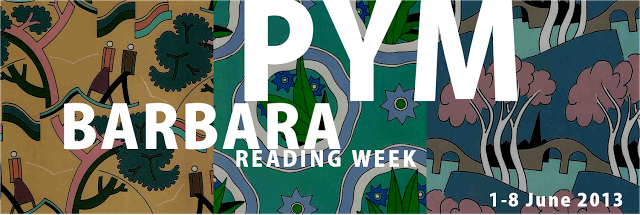
{review} barbara pym reading week


‘Reading, were you?’ Rupert picked up the book which lay on the little table by the fire. It turned out to be the poems of Tennyson, bound in green morocco. Could she really have been reading that? he wondered, looking around for the novel stuffed behind a cushion.
‘Yes, but I was just going to make some coffee,’ said Ianthe. ‘Would you like some?’
How convenient women were, Rupert thought, accepting her offer, the way they were always ‘just going’ to make coffee or tea or perhaps had just roasted a joint in the oven or made a cheese soufflé. (A Suitable Attachment)
I'm very late to the (tea?) party - though I have been playing along on twitter a little - but I have been so enjoying reading everyone's posts for Barbara Pym Reading Week, the brilliant idea of Thomas at My Porch and Amanda of Fig & Thistle. However, my new computer finally arrived yesterday (the whole saga is worthy of an entry to white whine, but I shan't bore you), so I'm back in blogging action now.

But, hey, plenty of time for reading without all those distractions provided by functioning technology, and I was really pleased that I managed to read five books by Barbara Pym this week. I loved them all, although I think that Excellent Women is my favourite (so far!).

So which ones did I read?


Excellent Women (1952) as I noted: wonderful, so funny and so sharp and quietly catty. And I was so happy to see Mildred Lathbury pop up (in name) in two other of my reads, so I found out what happened to her. This was my first Barbara Pym read, and I am now hooked. I may even like her more than Anita Brookner. Oh, perhaps not, but it is close...


Which is interesting, as my second read, Quartet in Autumn (1977) was a book with really Brooknerish resonances - about people who fail to "make contact" - although also reminiscent of another magnificent book about ageing, friendship and loneliness, Muriel Spark's Memento Mori {REVIEW}. It also captured the hideous ugliness of the 1970s really well.
Of the four only Letty used the library for her own pleasure and possible edification. She had always been an unashamed reader of novels, but if she hoped to find one which reflected her own sort of life she had come to realize that the position of an unmarried, unattached, ageing woman is of no interest whatever to the writer of modern fiction.


An Unsuitable Attachment (1963 - famously rejected by the publisher and not published until 1982) had a wonderful heroine in Ianthe, with her perfect little house and quiet careful life who is nevertheless prepared to take a chance on a happy ending rather than seek a safer alternative.
The man who had offered the seat had seen Ianthe as a tall fragile-looking woman in a pretty blue hat that matched her eyes. He might also have noticed that her dark hair was touched with grey and that although she was not exactly smart there was a kind of elegance about her. She saw herself perhaps as an Elizabeth Bowen heroine – for one did not openly identify oneself with Jane Austen’s heroines – and To The North was her favourite novel.
However, it was, obviously, the cat Faustina who really grabbed me in this one!
‘Yes – is that her coming now? I thought I saw somebody pass the window,’ said Sophia. Her tone was a little agitated for she had also just seen Faustina mount the refreshment table and pick her way delicately among the dishes of the cakes and savouries, sniffing the air, ready to pause and pounce when she came upon something that took her fancy.

After this I read Pym's first work, Some Tame Gazelle (1950), which was much more - like Excellent Women - obviously humorous in tone. I loved the sisters: Harriet, who likes to feed pale curates ("They were so immature and always made the same kind of conversation"), and the thoughtful Belinda who has loved the Archdeacon next door for thirty barren years.
She felt she could hardly agree that Agatha was elderly when she herself was a year older and thought of herself as only middle-aged. And yet, middle-aged or elderly, what was the difference really? Calm of mind, all passion spent … she had known that before she was thirty.
...
Belinda had decided to wear her blue chiffon. Henry had once said that he liked her in pale colours, and although that had been over thirty years ago it was possible that he still might.
The wicked one-liners in this book were quite wonderful. As a classicist, I am thinking of having this put on a t-shirt (perhaps in embroidery?): "I had a classical education and it isn’t a very good training for scintillating conversation."
‘Now, Ricardo, you mustn’t lose hope,’ said Belinda comfortably. ‘I know she is fond of you and even if she will not love you, always remember’ – her eyes lighted on the works of Alfred, Lord Tennyson – ‘that it is better to have loved and lost than never to have loved at all. I always think those lines are such a great comfort; so many of us have loved and lost.’ She frowned: nobody wanted to be one of many, and she did not like this picture of herself, only one of a great crowd of dreary women. Perhaps Tennyson was rather hackneyed after all.

Finally, I read Jane and Prudence (1953) about two university women whose lives have taken quite different paths, while their friendship has remained true. Can Jane find Prudence a suitable husband from the unmarried men (perhaps the handsome leonine philandering widower Fabian who has a large photo of himself on his wife's grave!) in the village where she tries but always fails to live up to her (literary) expectations of the appropriate activities for a vicar's wife?
‘Yes, of course,’ Jane agreed. ‘The church is going to look very nice, I think.’
‘Oh, Mother, you always say that,’ said Flora, Mrs Glaze having left them alone together. ‘And you never really notice.’
‘No, I notice the things one shouldn’t,’ said Jane.
I quite liked how a little bit of life at the time crept into this book - rationed food, for instance. I love reading about food in books, and Pym's books certainly offered me a lot of treats (apart from liver). I felt like a nice very dry sherry quite a bit as I read too; but not, I think, a madeira:
‘This is Madeira,’ said Mervyn. ‘It seems a suitable present for a respectable unmarried lady who might be visited by the clergy.’
The 'excellent women' ("It was not the excellent women who got married...") who carried the parish / village / suburb / street along in all these books thoroughly resonated with me (over-educated spinster, perhaps even "comfortably indifferent to dress?"!).
Prudence’s flat was in the kind of block where Jane imagined people might be found dead, though she had never said this to Prudence herself; it seemed rather a macabre fancy and not one to be confided to an unmarried woman living alone.
I also loved the literary allusions scattered so aptly through the texts. In addition, I was reminded that I enjoy books where nothing much seems to happen (so, my passion for Anita Brookner) and what does happen happens so quietly that it hardly creates a ripple. Of course, one doesn't want this in every book, but it is really very relaxing at times! It also amused me quite a lot that so many inhabitants of these books seemed to have jobs that no one quite knew what they were, including the employees, in a "vague cultural organisation" (J&P), or "something to do with records or filing, it was thought, nobody knew for certain" (Q in A). The ordinary, the everyday - these are the stars of these books.

I am so happy that I have the pleasure of eight more of Barbara Pym's books to enjoy in the future. Many thanks to Thomas and Amanda for creating Barbara Pym Reading Week!

Barbara Pym with cat

Monday, February 25, 2013

{review} heartburn

Nora Ephron Heartburn (1983)
If I had it to do over again, I would have made a different kind of pie. The pie I threw at Mark made a terrific mess, but a blueberry pie would have been even better, since it would have permanently ruined his new blazer, the one he bought with Thelma. But Betty said bring a Key lime pie, so I did.
A marker of how much I like a book is the irritating appearance of this little note when I check my Kindle highlights: "You have reached the clipping limit for this item". With Nora Ephron's Heartburn, this appeared well, well, well before I'd reached the end.


Why did I love it? Funny, heart-breaking, cynical, gorgeously written. Did I say funny? A survival text for picking yourself up and moving on. And it also has recipes! If you love tales of love, loss, lust and gluttony, this is for you.

My edition has a foreword by Ephron explaining that she wrote it after the break-up of her own marriage to the journalist Carl Bernstein (of Watergate fame). It caused quite a scandal at the time, being a thinly disguised semi-autobiographical account of how a wife discovers her husband's affair at a moment when she is seven months pregnant. 

Ephron's heroine is not strictly herself - as she notes, "One of the things I’m proudest of is that I managed to convert an event that seemed to me hideously tragic at the time to a comedy – and if that’s not fiction, I don’t know what is." 

Or, as her narrator puts it:
Vera said: ‘Why do you feel you have to turn everything into a story?’
So I told her why:
Because if I tell the story, I control the version.
Because if I tell the story, I can make you laugh, and I would rather have you laugh at me than feel sorry for me.
Because if I tell the story, it doesn’t hurt as much.
Because if I tell the story, I can get on with it.
Ephron's protagonist Rachel Samstat is a television cook and very much a New York girl ("‘Too New York’ is what the last network that was approached about me responded, which is a cute way of being anti-Semitic, but who cares?"). The failing marriage is not her first. And the responsibility for what has happened, as we see as the novel unfolds, is perhaps not as clear-cut as we are initially led to believe. There is a good deal of sheer selfishness, on both sides. But it is a tragedy, even if so wittily upcycled into comedy.  
If pregnancy were a book, they would cut the last two chapters. The beginning is glorious, especially if you’re lucky enough not to have morning sickness and if, like me, you’ve had small breasts all your life. Suddenly they begin to grow, and you’ve got them, you’ve really got them, breasts, darling breasts, and when you walk down the street they bounce, truly they do, they bounce bounce bounce. You find yourself staring in the mirror for long stretches of time, playing with them, cupping them in your hands, pushing them this way and that, making cleavage, making cleavage vanish, standing sideways, leaning over, sticking them out as far as they’ll go, breasts, fantastic tender apricot breasts, then charming plucky firm tangerines, and then, just as you were on the verge of peaches, oranges, grapefruit, cantaloupes, God knows what other blue-ribbon county-fair specimens, your stomach starts to grow, and the other fruits are suddenly irrelevant because they’re outdistanced by an honest-to-God watermelon. You look more idiotically out of proportion than ever in your life. You feel such nostalgia for the scrawny, imperfect body you left behind; and the commonsense knowledge that you will eventually end up shaped approximately the way you began is all but obliterated by the discomfort of not being able to sleep on your stomach and of peeing ever so slightly every time you cough and of leaking droplets from your breasts onto your good silk blouses and of suddenly finding yourself expert in mysteries you hadn’t expected to comprehend until middle age, mysteries like swollen feet, varicose veins, neuritis, neuralgia, acid indigestion and heartburn. Heartburn. That, it seemed to me as I lay in bed, was what I was suffering from. That summed up the whole mess: heartburn. Compound heartburn. Double-digit heartburn. Terminal heartburn.
The narrative structure works extremely well, cutting back and forwards and into the middle of her two major relationships. The action shifts between her beloved New York (home of all foodie delights) and her husband Mark's base in Washington ("a city where you can’t even buy a decent bagel"). Food - and what food can mean in relation to love and giving and sensuousness and sex - is terrifically important to the book.
But I realized as I stood there doing my demonstration in the middle of the Macy’s housewares department that I had been as dopey about food and love as any old-fashioned Jewish mother. I loved to cook, so I cooked. And then the cooking became a way of saying I love you. And then the cooking became the easy way of saying I love you. And then the cooking became the only way of saying I love you. I was so busy perfecting the peach pie that I wasn’t paying attention. I had never even been able to imagine an alternative. Every so often I would look at my women friends who were happily married and didn’t cook, and I would always find myself wondering how they did it. Would anyone love me if I couldn’t cook? I always thought cooking was part of the package: Step right up, it’s Rachel Samstat, she’s bright, she’s funny, and she can cook!
Seriously, I laughed, cried and drooled.
We had driven miles to find the world’s creamiest cheesecake and the world’s largest pistachio nut and the world’s sweetest corn on the cob. We had spent hours in blind taste testings of kosher hot dogs and double chocolate chip ice cream. When Julie went home to Fort Worth, she flew back with spareribs from Angelo’s Beef Bar-B-Q, and when I went to New York, I flew back with smoked butterfish from Russ and Daughters. Once, in New Orleans, we all went to Mosca’s for dinner, and we ate marinated crab, baked oysters, barbecued shrimp, spaghetti bordelaise, chicken with garlic, sausage with potatoes, and on the way back to town, a dozen oysters each at the Acme and beignets and coffee with chicory on the wharf. Then Arthur said, ‘Let’s go to Chez Helene for the bread pudding,’ and we did, and we each had two. The owner of Chez Helene gave us the bread pudding recipe when we left, and I’m going to throw it in because it’s the best bread pudding I’ve ever eaten. It tastes like caramelized mush. Cream 2 cups sugar with 2 sticks butter. Then add 2½ cups milk, one 13-ounce can evaporated milk, 2 tablespoons nutmeg, 2 tablespoons vanilla, a loaf of wet bread in chunks and pieces (any bread will do, the worse the better) and 1 cup raisins. Stir to mix. Pour into a deep greased casserole and bake at 350° for 2 hours, stirring after the first hour. Serve warm with hard sauce.
Highly recommended. 

Saturday, February 16, 2013

{poem} figs

Sometimes life does mirror art (like road-tripping with a book on pies).

It's fig season here in Adelaide. Intoxicating...

(sorry, I don't manicure)

D.H. Lawrence nails some of the fig-eating essentials, along with a healthy dose of clichéd symbolism and a dubious measure of misogyny.

D.H. Lawrence: Figs

The proper way to eat a fig, in society,
Is to split it in four, holding it by the stump,

And open it, so that it is a glittering, rosy, moist, honied, heavy-petalled four-petalled flower.

Then you throw away the skin
Which is just like a four-sepalled calyx,
After you have taken off the blossom, with your lips.

But the vulgar way
Is just to put your mouth to the crack, and take out the flesh in one bite.

Every fruit has its secret.

The fig is a very secretive fruit.
As you see it standing growing, you feel at once it is symbolic:
And it seems male.
But when you come to know it better, you agree with the Romans, it is female.

The Italians vulgarly say, it stands for the female part; the fig-fruit:
The fissure, the yoni,
The wonderful moist conductivity towards the centre.

Involved,
Inturned,
The flowering all inward and womb-fibrilled;
And but one orifice.

The fig, the horse-shoe, the squash-blossom.
Symbols.

There was a flower that flowered inward, womb-ward;
Now there is a fruit like a ripe womb.

It was always a secret.
That’s how it should be, the female should always be secret.

There never was any standing aloft and unfolded on a bough
Like other flowers, in a revelation of petals;
Silver-pink peach, venetian green glass of medlars and sorb-apples,
Shallow wine-cups on short, bulging stems
Openly pledging heaven:
Here’s to the thorn in flower! Here is to Utterance!
The brave, adventurous rosaceae.

Folded upon itself, and secret unutterable,
And milky-sapped, sap that curdles milk and makes ricotta,
Sap that smells strange on your fingers, that even goats won’t taste it;
Folded upon itself, enclosed like any Mohammedan woman,
Its nakedness all within-walls, its flowering forever unseen,
One small way of access only, and this close-curtained from the light;
Fig, fruit of the female mystery, covert and inward,
Mediterranean fruit, with your covert nakedness,
Where everything happens invisible, flowering and fertilization, and fruiting
In the inwardness of your you, that eye will never see
Till it’s finished, and you’re over-ripe, and you burst to give up your ghost.

Till the drop of ripeness exudes,
And the year is over.

And then the fig has kept her secret long enough.
So it explodes, and you see through the fissure the scarlet.
And the fig is finished, the year is over.

That’s how the fig dies, showing her crimson through the purple slit
Like a wound, the exposure of her secret, on the open day.
Like a prostitute, the bursten fig, making a show of her secret.

That’s how women die too.

The year is fallen over-ripe,
The year of our women.
The year of our women is fallen over-ripe.
The secret is laid bare.
And rottenness soon sets in.
The year of our women is fallen over-ripe.

When Eve once knew in her mind that she was naked
She quickly sewed fig-leaves, and sewed the same for the man.
She’d been naked all her days before,
But till then, till that apple of knowledge, she hadn’t had the fact on her mind.

She got the fact on her mind, and quickly sewed fig-leaves.
And women have been sewing ever since.
But now they stitch to adorn the bursten fig, not to cover it.
They have their nakedness more than ever on their mind,
And they won’t let us forget it.

Now, the secret
Becomes an affirmation through moist, scarlet lips
That laugh at the Lord’s indignation.

What then, good Lord! cry the women.
We have kept our secret long enough.
We are a ripe fig.
Let us burst into affirmation.

They forget, ripe figs won’t keep.
Ripe figs won’t keep.

Honey-white figs of the north, black figs with scarlet inside, of the south.
Ripe figs won’t keep, won’t keep in any clime.
What then, when women the world over have all bursten into affirmation?
And bursten figs won’t keep?

(There are some variant readings which I haven't noted here. Lazy. Ditto formatting).


{READ IN 2018}

  • FEBRUARY
  • 30.
  • 29.
  • 28.
  • 27.
  • 26. The Grave's a Fine & Private Place - Alan Bradley
  • 25. This is What Happened - Mick Herron
  • 24. London Rules - Mick Herron
  • 23. The Third Eye - Ethel Lina White
  • 22. Thrice the Brindled Cat Hath Mewed - Alan Bradley
  • 21. As Chimney Sweepers Come to Dust - Alan Bradley
  • 20. The Dead in Their Vaulted Arches - Alan Bradley
  • 19. Speaking from Among the Bones - Alan Bradley
  • JANUARY
  • 18. Eleanor Oliphant is Completely Fine - Gail Honeyman
  • 17. Miss Ranskill Comes Home - Barbara Euphan Todd
  • 16. The Long Arm of the Law - Martin Edwards (ed.)
  • 15. Nobody Walks - Mick Herron
  • 14. The Talented Mr Ripley - Patricia Highsmith
  • 13. Portrait of a Murderer - Anthony Gilbert
  • 12. Murder is a Waiting Game - Anthony Gilbert
  • 11. Tenant for the Tomb - Anthony Gilbert
  • 10. Death Wears a Mask - Anthony Gilbert
  • 9. Night Encounter - Anthony Gilbert
  • 8. The Visitor - Anthony Gilbert
  • 7. The Looking Glass Murder - Anthony Gilbert
  • 6. The Voice - Anthony Gilbert
  • 5. The Fingerprint - Anthony Gilbert
  • 4. Ring for a Noose - Anthony Gilbert
  • 3. No Dust in the Attic - Anthony Gilbert
  • 2. Uncertain Death - Anthony Gilbert
  • 1. She Shall Died - Anthony Gilbert

{READ IN 2017}

  • DECEMBER
  • 134. Third Crime Lucky - Anthony Gilbert
  • 133. Death Takes a Wife - Anthony Gilbert
  • 132. Death Against the Clock - Anthony Gilbert
  • 131. Give Death a Name - Anthony Gilbert
  • 130. Riddle of a Lady - Anthony Gilbert
  • 129. And Death Came Too - Anthony Gilbert
  • 128. Snake in the Grass - Anthony Gilbert
  • 127. Footsteps Behind Me - Anthony Gilbert
  • 126. Miss Pinnegar Disappears - Anthony Gilbert
  • 125. Lady-Killer - Anthony Gilbert
  • 124. A Nice Cup of Tea - Anthony Gilbert
  • 123. Die in the Dark - Anthony Gilbert
  • 122. Death in the Wrong Room - Anthony Gilbert
  • 121. The Spinster's Secret - Anthony Gilbert
  • 120. Lift up the Lid - Anthony Gilbert
  • 119. Don't Open the Door - Anthony Gilbert
  • 118. The Black Stage - Anthony Gilbert
  • 117. A Spy for Mr Crook - Anthony Gilbert
  • 116. The Scarlet Button - Anthony Gilbert
  • 115. He Came by Night - Anthony Gilbert
  • 114. Something Nasty in the Woodshed - Anthony Gilbert
  • NOVEMBER
  • 113. Death in the Blackout - Anthony Gilbert
  • 112. The Woman in Red - Anthony Gilbert
  • 111. The Vanishing Corpse - Anthony Gilbert
  • 110. London Crimes - Martin Edwards (ed.)
  • 109. The Midnight Line - Anthony Gilbert
  • 108. The Clock in the Hatbox - Anthony Gilbert
  • 107. Dear Dead Woman - Anthony Gilbert
  • 106. The Bell of Death - Anthony Gilbert
  • 105. Treason in my Breast - Anthony Gilbert
  • 104. Murder has no Tongue - Anthony Gilbert
  • 103. The Man who Wasn't There - Anthony Gilbert
  • OCTOBER
  • 102. Murder by Experts - Anthony Gilbert
  • 101. The Perfect Murder Case - Christopher Bush
  • 100. The Plumley Inheritance - Christopher Bush
  • 99. Spy - Bernard Newman
  • 98. Cargo of Eagles - Margery Allingham & Philip Youngman Carter
  • 97. The Mind Readers - Margery Allingham
  • SEPTEMBER
  • 96. The China Governess - Margery Allingham
  • 95. Hide My Eyes - Margery Allingham
  • 94. The Beckoning Lady - Margery Allingham
  • 93. The Tiger in the Smoke - Margery Allingham
  • 92. More Work for the Undertaker - Margery Allingham
  • 91. Coroner's Pidgin - Margery Allingham
  • 90. Traitor's Purse - Margery Allingham
  • 89. The Fashion in Shrouds - Margery Allingham
  • 88. The Case of the Late Pig - Margery Allingham
  • 87. Dancers in Mourning - Margery Allingham
  • AUGUST
  • 86. Flowers for the Judge - Margery Allingham
  • 85. Death of a Ghost - Margery Allingham
  • 84. Sweet Danger - Margery Allingham
  • 83. Police at the Funeral - Margery Allingham
  • 82. Look to the Lady - Margery Allingham
  • 81. Mystery Mile - Margery Allingham
  • 80. The Crime at Black Dudley - Margery Allingham
  • 79. The White Cottage Mystery - Margery Allingham
  • 78. Murder Underground - Mavis Doriel Hay
  • 77. No Man's Land - David Baldacci
  • 76. The Escape - David Baldacci
  • 75. The Forgotten - David Baldacci
  • 74. Zero Day - David Baldacci
  • JULY
  • 73. Pilgrim's Rest - Patricia Wentworth
  • 72. The Case is Closed - Patricia Wentworth
  • 71. The Watersplash - Patricia Wentworth
  • 70. Lonesome Road - Patricia Wentworth
  • 69. The Listening Eye - Patricia Wentworth
  • 68. Through the Wall - Patricia Wentworth
  • 67. Out of the Past - Patricia Wentworth
  • 66. Mistress - Amanda Quick
  • 65. The Black Widow - Daniel Silva
  • 64. The Narrow - Michael Connelly
  • 63. The Poet - Michael Connelly
  • 62. The Visitor - Lee Child
  • 61. No Middle Name: The Complete Collected Jack Reacher Stories - Lee Child
  • JUNE
  • 60. The Queen's Accomplice - Susan Elia MacNeal
  • 59. Mrs Roosevelt's Confidante - Susan Elia MacNeal
  • 58. The PM's Secret Agent - Susan Elia MacNeal
  • 57. His Majesty's Hope - Susan Elia MacNeal
  • 56. Princess Elizabeth's Spy - Susan Elia MacNeal
  • 55. Mr Churchill's Secretary - Susan Elia MacNeal
  • 54. A Lesson in Secrets - Jacqueline Winspear
  • 53. Hit & Run - Lawrence Block
  • 52. Hit Parade - Lawrence Block
  • 51. Hit List - Lawrence Block
  • 50. Six Were Present - E. R. Punshon
  • 49. Triple Quest - E. R. Punshon
  • MAY
  • 48. Dark is the Clue - E. R. Punshon
  • 47. Brought to Light - E. R. Punshon
  • 46. Strange Ending - E. R. Punshon
  • 45. The Attending Truth - E. R. Punshon
  • 44. The Golden Dagger - E. R. Punshon
  • 43. The Secret Search - E. R. Punshon
  • 42. Spook Street - Mick Herron
  • 41. Real Tigers - Mick Herron
  • 40. Dead Lions - Mick Herron
  • 39. Slow Horses - Mick Herron
  • APRIL
  • 38. Everybody Always Tells - E. R. Punshon
  • 37. So Many Doors - E. R. Punshon
  • 36. The Girl with All the Gifts - M. R. Carey
  • 35. A Scream in Soho - John G. Brandon
  • 34. A Murder is Arranged - Basil Thomson
  • 33. The Milliner's Hat Mystery - Basil Thomson
  • 32. Who Killed Stella Pomeroy? - Basil Thomson
  • 31. The Dartmoor Enigma - Basil Thomson
  • 30. The Case of the Dead Diplomat - Basil Thomson
  • 29. The Case of Naomi Clynes - Basil Thomson
  • 28. Richardson Scores Again - Basil Thomson
  • 27. A Deadly Thaw - Sarah Ward
  • MARCH
  • 26. The Spy Paramount - E. Phillips Oppenheim
  • 25. The Great Impersonation - E. Phillips Oppenheim
  • 24. Ragdoll - Daniel Cole
  • 23. The Case of Sir Adam Braid - Molly Thynne
  • 22. The Ministry of Fear - Graham Greene
  • 21. The Draycott Murder Mystery - Molly Thynne
  • 20. The Murder on the Enriqueta - Molly Thynne
  • 19. The Nowhere Man - Gregg Hurwitz
  • 18. He Dies and Makes No Sign - Molly Thynne
  • FEBRUARY
  • 17. Death in the Dentist's Chair - Molly Thynne
  • 16. The Crime at the 'Noah's Ark' - Molly Thynne
  • 15. Harriet the Spy - Louise Fitzhugh
  • 14. Night School - Lee Child
  • 13. The Dancing Bear - Frances Faviell
  • 12. The Reluctant Cannibals - Ian Flitcroft
  • 11. Fear Stalks the Village - Ethel Lina White
  • 10. The Plot - Irving Wallace
  • JANUARY
  • 9. Understood Betsy - Dorothy Canfield Fisher
  • 8. Give the Devil his Due - Sulari Gentill
  • 7. A Murder Unmentioned - Sulari Gentill
  • 6. Dead Until Dark - Charlaine Harris
  • 5. Gentlemen Formerly Dressed - Sulari Gentill
  • 4. While She Sleeps - Ethel Lina White
  • 3. A Chelsea Concerto - Frances Faviell
  • 2. Kipps: The Story of a Simple Soul - H. G. Wells
  • 1. Heft - Liz Moore
Free Delivery on all Books at the Book Depository