Showing posts with label australia. Show all posts

Monday, June 9, 2014

{review} a week of pineapples

*dusts off blog cobwebs*
'Georgy,' Mr Pasmore asks, 'may we come in?' He was already in. 'I’ve brought you two delightful visitors. They have been exploring the possibility of the pineapple. Do you like that? The possibility of? I mean we all know the positivity of, don't we? What we want, oh, what we all so want want want is the possibility of? Georgy, do you believe in the possibility of the pineapple?' (Thea Astley, Hunting the Wild Pineapple)
Last week I only read books with 'pineapple' in the title. This offered a wider variety than one might expect, and I think I did rather well and read some things I might not otherwise have tackled. So what did I read?


M. C. Beaton At the Sign of the Golden Pineapple (1987)
Charlotte Webster awoke during the night and lay shivering under her thin blankets. Food. Mountains of food. That’s what she had been dreaming of. A confectioner’s. She could see it now, the golden pineapple over the door, the piles of oranges and pineapples and dainty cakes. The smells of hot chocolate and coffee. Her stomach growled ferociously.
M. C. Beaton is terrifyingly prolific. This Regency series was originally published under the pen name Marion Chesney. I discovered this series thanks to Another Look Book's review of Beaton/Chesney's Minerva, which I thought could fill a Heyer-sized gap in my reading life. It was less-mannered, more overtly - perhaps one might suggest 'unbelievably' - socially boundary-pushing, and rather more risqué than a Heyer, but a fun - and quick - read. Likewise At the Sign of the Golden Pineapple: our heroine ("We are all kept in chains by the fact that we are genteel women") decides to make her own way by opening a confectionery shop/ices-and-tea-room in London with two lady acquaintances from unhappy homes - but can "ladies" ever resume their previous social and marital ambitions after working in a shop? 

The pineapple connection is that a pineapple was an emblem of the confectionery trade in the Georgian era (lots more on this here and a wonderful recreated pineapple 'ice' here). This is a (hmmm... tries to think of some relevant analogies...) wafer-thin read, stuffed sugarplum-like with sweet historical details, and easily digestible in one sitting. Not sure I'm hungry for more of the genre though, but that might be a result of the sugar overdose of read number two...

Betty Neels Pineapple Girl (1977)


And Mrs White, with a swift movement worthy of a magician, heaved at something under the blankets and produced a pineapple. ‘Oh!’ said Eloise, startled, and then: ‘Mrs White, what a simply lovely present—thank you, and your husband. I’ve—I’ve never had such a delightful surprise.’ She clasped the fruit to her person...
I've actually read this Mills & Boon before, and written briefly about it. Nurse falls down steps onto handsome foreign doctor while holding a pineapple; doctor replaces pineapple with THREE from Fortnum & Mason; coincidentally, poor nurse meets handsome doctor in foreign parts while on a job; does he love her or is he a bastard ("How could he talk about kippers when only a moment ago he had been kissing her as though he really enjoyed it?")? Will her clothes be good enough ("an elderly velvet dress the colour of a mole")? ... yada yada yada... You get the picture. I'm here for the pineapples, mostly, I guess. The period details (grimy 70s London) are great, and often rendered rather funny by time-passed:
‘Someone gave me a pineapple,’ she informed the table at large, and added apologetically: ‘I would have brought it down with me, but I thought it would have been nice to take home…’ There was a chorus of assent; everyone there knew that Eloise lived in a poky little flat behind the Imperial War Museum—true, it was on the fringe of a quite respectable middle-class district, but with, as it were, an undesirable neighbourhood breathing down its neck...
My favourite line is when the heroine is tossing and turning at night thinking about the mysterious doctor: "a fruitless exercise". I think NOT!

But I haven't only read pineapple 'fluff':


Thea Astley Hunting the Wild Pineapple (1979)
Once in Fixer’s cabin, one hour, one year, Fixer and I worked out the new coat of arms - a beer can rampant on a social security form couchant. Do we make it different, the people up here?
I don't read as much Australian literature as I feel I ought: I think this is a combination of the feeling that I "ought" (which makes me irrationally stubbornly resistant to doing so); a lack of empathy or resonance with the "bush" (I blame family camping holidays and a loathing of tropical weather), and a love of reading about places not as familiar as the home turf. Perhaps there's a bit of a block too because of difficult reading experiences with Australian lit at school and university? But I do keep trying. 

I can't say that I felt any sense of breakthrough after reading Thea Astley's take on Far North Queensland - hot, wet, uncomfortable, primitive, dangerous - a "soft porn" of a landscape - and filled with the lost and those not wanting to be found. This is a land where social boundaries break easily: "Carl’s fingers have been scratching the spines of Mac’s books. He wants to borrow a couple. I explain they’re not mine, but he’s oblivious to the protocol that goes with possession."

Astley's writing is absolutely superb, although sometimes one feels on the verge of drowning in it. (Whispering Gums discusses why Astley's language can also be confronting.) The book is a series of interlinked short stories about the inhabitants of the tropical Far North. Her descriptions of place can be claustrophobia-inducing - small artificially created physical and metaphorical spaces within which we imprison ourselves, and then the equally terrible world without: "a postcard tropadise (the greens are too green! the blues too blue!)". 

Then there are moments of pure comedy (like the 'hunt' for the wild pineapple of the title) or the little vignettes of everyday life such as the blind date: "He was much older than she had expected. So was she." Elsewhere: "She always appeared formidably silked and hatted and her bust was frightening. ‘Breasts’ is somehow too pretty, too delicate a word to describe that shelf of righteousness on which many a local upstart had foundered."
Mr Waterman was, also, a foundation member of the metric society. He was the first in the district to think in millimetres of rain, kilometres of road, kilograms of body fat and the metric statistics of wanted criminals. When he and Mrs Waterman did their biennial culture junket to Europe, he took enormous pleasure in supplying details for his passport. ‘One point eight five four three metres,’ he wrote against ‘height’; ‘eyes’ – ‘blue’. He would chide his wife mildly. ‘No, dear. No, no. You are one point six four one two metres.’ Against ‘colour of eyes’ she wrote ‘glazed’.
A difficult but valuable read.

Kaori O'Connor Pineapple: A Global History (2013)


Pineapple is great. She is almost too transcendent - a delight if not sinful, yet so like sinning that really a tender conscienced person would do well to pause - too ravishing for mortal taste, she woundeth and excoriateth the lips that approach her - like lovers’ kisses she biteth - she is a pleasure bordering on pain, from the fierceness and insanity of her relish. (Charles Lamb, Essays of Elia [1823])
I have a copy of Fran Beauman's The Pineapple on my shelf, but I decided to read this shorter history first. It's part of a series of books devoted to single foodstuffs - nuts, pancakes, pies, soup, offal, etc. (Incidentally, Pie is by the always fascinating blogger Old Foodie.) Pineapple is basically all you need to know about the pineapple in the short form: where it came from, how it got everywhere, its role as a prestige and royal object, the craziness of growing it in England, the popularization of the fruit through canning, and so on.
Indeed, the gulf between the pineapple’s fame and the difficulty in satisfying curiosity as to its taste came to epitomize the nature of knowledge itself for the serious-minded. In his On Human Understanding, published in 1690, the empiricist philosopher John Locke used the pineapple to argue that true knowledge can only be based on experience. In Locke’s words: If you doubt this, see whether you can by words give anyone who has never tasted pineapple an idea of the taste of that fruit. He may approach a grasp of it by being told of its resemblance to other tastes of which he already has the ideas in his memory, imprinted there by things he has taken into his mouth; but this isn’t giving him that idea by a definition, but merely raising up in him other simple ideas that will still be very different from the true taste of pineapple.
I thought this a very readable book, although I think it dealt rather tentatively (but without omission) with some of the unpleasant aspects of the pineapple trade, for instance the connection with the slave trade. It was also weak, I thought, on the place of the pineapple in Australia. I am looking forward to finding out if Fran Beauman's book is better on this. I am also looking forward to an exhibition on the pineapple's importance to Queensland that will open in Brisbane this year. *plans a little holiday*

So, what did I get from my week of 'pineapple' reads? Predictable romance is enhanced by pineapples. Pineapple skin demonstrates the Fibonacci sequence. "In organoleptic terms, the pineapple’s great contribution has been the unique ‘sweet-and-sour’ taste." Pineapples have permeated all levels of society, and now I know why and how. Isn't abacaxi a great word? Pineapples feature in philosophical discourse. I can never holiday anywhere north of Brisbane. I'd really like a pineapple upside-down cake now. Here's one I made earlier...


Wednesday, November 13, 2013

{reviews} bleak books: barnard, west, block

Whoa, so... 
                 far... 
                         behind... 
                                       with reviewing. 

I'll start with three books offering a bleak - but more or less amusing - look at the seedier side of the lives of academics, journalists, and, er, hit men.

Robert Barnard Death of an Old Goat (1974)


Professor Wickham was giving a tutorial. Or rather, he was being given one. Every year he put Hardy as late in the term as possible, hoping that by then his first-year students would have become reasonably chatty. This was because he never could be quite sure which Hardy novel it was he had read. Whichever it was, it had left on his mind a vague impression of doom and landscape, but nothing much else remained.
This is a very funny book about academia and country Australia. Barnard (who died this year) has a brilliant eye for the difficult life facing the second-rate Oxbridge academic exiled to an uncomfortable and ugly rural university ("Even the Queen had managed to avoid it on most of her visits to Australia, and there were few places in Australia of which that could be claimed.") of the type which sprang up in Australia from the 1950s onwards. 

The 'old goat' is Professor Belville-Smith, an elderly Oxford don on a lecture tour of the provinces. He is a typically dry academic figure, full of snobbish distaste - and "senile malice" - for the colleagues he encounters ("tut-tut[ting] mentally at their vowel-sounds and their shirts"); and no one is particularly looking forward to listening to him either, given he "had been delivering that lecture since 1922" (!). But it would seem that the Old Goat knows something about one of the academics he encounters, and what he knows will lead to his brutal death... 

The crime was fairly easy to figure out, but this book was elevated above the ordinary for me by Barnard's absolutely wicked sense of humour about the snobbishness of Australian academia ("This is what one gets for employing Adult Education lecturers who got their degrees at Leeds, thought Wickham grimly.") and the rural 'squattocracy' who provided the social background to all the university's activities ("'Just like the Wickhams to let the drink run out,' said Mrs McKay, a little tipsily, to Mrs Lullham. 'They’re only academics, after all, however much they try to hide it.'"). 

The actual crime, and the inexperienced macho racist cop assigned to solve it, were far less interesting than the setting and eccentric characters who-[might have]-dunnit. (I discovered this book thanks to clothes in books.)

Nathanael West Miss Lonelyhearts (1933)

"Perhaps I can make you understand. Let's start from the beginning. A man is hired to give advice to the readers of a newspaper. The job is a circulation stunt and the whole staff considers it a joke. He welcomes the job, for it might lead to a gossip column, and anyway he's tired of being a leg man. He too considers the job a joke, but after several months at it, the joke begins to escape him. He sees that the majority of the letters are profoundly humble pleas for moral and spiritual advice, that they are inarticulate expressions of genuine suffering. He also discovers that his correspondents take him seriously. For the first time in his life, he is forced to examine the values by which he lives. This examination shows him that he is the victim of the joke and not its perpetrator."
Ouch. What a book. Like being mentally excoriated with a wire brush. Like the best sort of totally black satire. No glimmer of relief, no hint of light, and certainly no hint of escape in here. But also funny - well, sort of funny. Uncomfortable, ghastly funny... 

What hope is there for the writer of the lonely hearts column ("the priests of twentieth-century America") in Depression America? Alcoholic, depressed, unloved and unlovable ("his heart remained a congealed lump of icy fat"), prone to fighting, poor at grasping cues, misunderstood, self-defeating ("he stumbled purposely, so that she would take his confusion for honest feeling"), numb from suffering ("more than thirty letters, all of them alike, stamped from the dough of suffering with a heart-shaped cookie knife"), doomed... 

There's a lot going on here about the body too that I think I haven't properly grasped (when I wikipedia-ed it, apparently it is "Bergsonian" - I am in no way enlightened. Also existential. And Expressionist. Hmmm.). How can something so horribly bleak also be funny? 

A classic: I'm glad I've finally read, but oh how miserable I felt after I finished.

Lawrence Block Hit Man (1998)

He took the exit for the mall and found a parking place, taking careful note of where it was so he could find it again. Once, a couple of years ago, he had parked a rental car at a mall in suburban Detroit without paying attention to where he’d parked it or what it looked like. For all he knew it was still there.
A likeable hit man? A dog-loving stamp-collecting likeable hit man in need of a good psychiatrist? The 'voice' of Block's professional killer is just wonderful - sort of pensive, thoughtful, idealistic, melancholy, desperate to feel needed - a 'good' man despite his terrible day job. This book is a series of short stories ostensibly about John Keller's assignments, but really about what has made him the man he is today. If you like slowish little polished gems (someone sweetening a coffee "stirred it long enough to dissolve marble chips") about moral ambiguity, then these are for you.
He did that sometimes. Looked up his name in the phone books of strange cities, as if he might actually find himself there. Not another person with the same name, that happened often enough, his was not an uncommon name. But find himself, his actual self, living an altogether different life in some other city.
Lawrence Block died this year too (I see a theme here). This is the first of his books I've read, but I'm very keen to read more now. (I found this book thanks to belle, book and candle.)

*

Note [27/11/2013]: Brona remind me that I should link my Barnard post to her wonderful AusReading Month. Please do visit her blog for links to many, many interesting posts on Australian books and writers.


Monday, April 29, 2013

{review} a little bush maid

This is another review for Kim at Reading Matters' Australian Literature Month. Kim is generously donating 50p to the Indigenous Literacy Foundation for each review she receives for the month that links to her blog.


Mary Grant Bruce A Little Bush Maid (1910) & Mates at Billabong (1912)
She was perfectly aware that while Daddy wanted a mate he also wanted a daughter; and there was never any real danger of her losing that gentler attribute—there was too much in her of the little dead mother for that. Brownie, the ever watchful, had seen to it that she did not lack housewifely accomplishments, and Mr. Linton was wont to say proudly that Norah's scones were as light as her hand on the horse's mouth.


I have an ambivalent relationship with the Australian bush, the result of a teenagehood of family camping holidays with two keen parents and three much younger siblings. In fact, I shudder at writing 'camping' and 'holiday' in the same sentence. Our misguided (literally, if it was my job to read the map) forays away from civilisation exposed me to much of my home-state, South Australia. I am grateful for having seen so much (race-day riots at Coober Pedy), experienced so many things (feral cats in one's sleeping-bag), and been exposed to every extreme of temperature that this great land is capable of producing in spectacular abundance when one is forced to endure life under canvas. 

The 'Bush' - that bit of Australia that is neither urban nor Outback - is quite astonishingly beautiful:

 
This is in the Grampians, in Victoria (Feb. 2013).

But it is also filled with a variety of hazards ranging from the merely inconvenient (no showers!) to the downright deadly:

The Giant Koala (Feb. 2013)

I am, I readily confess, no Norah Linton:
She loved the bush, and was never happier than when exploring its recesses. A born bushmaid, she had never any difficulty about finding her way in the scrub, or of retracing her steps. The faculty of bushmanship must be born in you; if you have it not naturally, training very rarely gives it.
It is no surprise, therefore, that it took me until over the age of forty to pick up these classics of Australian children's fiction, the first two books of the 'Billabong' series. Mary Grant Bruce's stories (fifteen in all) of Norah Linton, her kindly father, big brother Jim and his mates from school, and the inhabitants of Billabong Station are classics of their kind.
Norah's home was on a big station in the north of Victoria–so large that you could almost, in her own phrase, "ride all day and never see any one you didn't want to see"; which was a great advantage in Norah's eyes. Not that Billabong Station ever seemed to the little girl a place that you needed to praise in any way. It occupied so very modest a position as the loveliest part of the world!
The two books that I have read (so far!) have many positives: the heroine, Norah, is a strong, self-sufficient, smart young woman, who has been brought up to think for herself and be kind to others. There are few things that she is not allowed to do (as a woman in the early twentieth century), and many, many things that she can do regardless of her sex, and sometimes far better than the blokes. I thought she was an excellent role-model. 

The bush is not depicted as a bucolic paradise, a sort of child's Eden: rather, the bush is a place where one has to work hard all the time to hold on to what is important; it holds unspeakable dangers for the naïve and unwary, and heartbreaking tragedy may lurk around every corner (are there corners in the bush?). Yet it is also a place of great community solidarity - a place where people help each other in times both good and bad. And, significantly, it is a place of great and healing beauty.

The negatives are mostly due to the series' grand old age and for that reason must be forgiven: the modern reader will cringe at the presentation of Aborigines ("That's a good boy," said Norah, approvingly, and black eighteen grinned from ear to ear with pleasure at the praise of twelve-year-old white) and non-white foreigners (although I note that Norah is generally open-minded about those she encounters) and, amusingly, almost anyone from a town:
And one of our men has gone down with the heat and can't field—fellow from the hotel with red hair, who made five—remember him, Wal.? He's out of training, like most hotel chaps, and as soft as possible, So we're playing a man short."
Curiously, she also has no time for the more generously fleshed: "she held the view that it was better to be dead than fat". In this, her outlook might appear excessively modern.

While Norah gains an enormous amount of outdoor experience (and can cook, sew and housekeep like an angel of the house), other aspects of her education are less satisfactory (until she is packed off to school):
Norah never could make out the people who pitied her for having no friends of her own age. How could she possibly be bothered with children, she reflected, when she had Daddy? As for Norah's education, that was of the kind best defined as a minus quantity. "I won't have her bothered with books too early," Mr. Linton had said when nurse hinted, on Norah's eight birthday, that it was time she began the rudiments of learning. "Time enough yet–we don't want to make a bookworm of her!"
In the first two books in the series, Norah deals with bushfires and typhoid, reunites a broken family, encounters heartbreaking loss and nearly loses her beloved father, tries to get to grips with city habits ("Further off came the cheerful voices of Jim and Wally on their way to the lagoon. Cecil preferred the bath in the house, saying that he considered it cleaner, which remark had incensed Norah at the time"), has a narrow brush with a fate worse than death, and prepares herself to be sent away from her beloved Billabong to a girls' school in Melbourne. I gather that, in the next books, the family travels to London, fights in the First World War (written contemporaneously), and is eventually reunited in our bush paradise. 

I am keen to read on; however, while some of the series are in the public domain in other countries (at Project Gutenberg; or Girlebooks), the series is still in copyright in Australia under a family trust (info). I plan to collect myself some nicer old editions as I see them.


In sum: well-written children's adventure stories with a strong female heroine. Dated, but rollicking good reads. 

Thanks again to Kim for coordinating Australian Literature Month!

Monday, April 22, 2013

{review} eat me

Linda Jaivin Eat Me (Text Classics: 2012 [1995])

This is a review for Kim at Reading Matters' Australian Literature Month.


Kim is donating 50p to the Indigenous Literacy Foundation for each review she receives for the month that links to her blog. The Indigenous Literacy Foundation "aims to raise literacy levels and improve the lives and opportunities of Indigenous children living in remote and isolated regions. This is done by providing books and literacy resources to communities and raising broad community awareness of Indigenous literacy issues." (source). This is an excellent cause and I have clicked over and made a donation which "will buy 3 or more books for an indigenous child living in a remote community."

But, the review... (and, incidentally, I do not think that this will be a book handed out to children unless something goes rather wrong in the distribution process.)


Text Classics offer new editions of Australian books, "milestones in the Australian experience". I picked Linda Jaivin's Eat Me, first published in 1995, because it seems to have totally missed my radar, and I suspect that was because I was living in the UK in the second half of the 90s. I imagine that I missed rather a lot of Australian writing in those poor student days. I also picked it because I like books that link food and sex in interesting ways. That said, I may never be able to look at grapes in quite the same way again.

It was a warm night. He was just wearing a t-shirt and jeans. He was probably in his fifties and, as he bent over the hood, I got a good look at him. I was still thinking along the lines of how I would describe him to the police.
Eat Me is a very funny collection of erotic stories with a distinctly Australian voice, setting and aesthetic. (Although fortunately not always as memorably antipodean as "sucking to the beat of 'Waltzing Matilda'.") Set mostly in Sydney (but with a wholly unforgettable scene set at the Big Merino), it ostensibly relates the tales told by four very modern women who meet up - café society! - and offer each other stories based, one is led to believe, on personal experience. But this easy narrative style soon begins to break down both for the women and for the reader, and by the end of this very well structured book one finds oneself (as do the narrators) somewhat at a loss about what is real and what is not. Can these stories even be real, one might (even) ask? 

This ambiguity begins to extend to Eat Me-the-book itself, trapping the reader in a very pleasant puzzle about what it is they are, in fact, reading: reading erotica about listening to erotica read by writers of erotica writing erotica from female and male perspectives... and so on!
Without further ado, he rolled on top and entered her. A zillion images flooded into his head: of marscapone, of Sharon Stone, of steaming cannelloni, of lingerie, of Elle Macpherson, of stallions, of stamens, of Mal Meninga on a run, of Madonna on a gondola, of cocker spaniels, Mick Jagger’s lips, of ET, of wet t-shirt contests, of mangos, of his father swinging a golf club, of a platypus wriggling its way down a muddy river. Much to his horror, Beavis and Butthead provided the soundtrack, laughing: hehheh hehheh hehheh.
This ambiguity is heightened, I thought, by Jaivin's use of a number of the stereotypes of erotic encounters: the mysterious sudden absence of all witnesses to very public sex acts; exaggerated, er [trying not to get myself blocked here!], manhood (shall we say?!); the ease of sexual conquest; an exaggerated brutality of genital language (love blender; goluptious trough); to name but a few. My assumption was that these features were deliberately signposting the fault-lines between reality and fantasy, that is, sexing up the intellectual calibre of erotic writing at the same it is implicitly undermined. 

As one loses one's footing in the narrative, tripped up by its multiple narrators (unreliable? fictional? female? male? quasi-autobiographical?!) with distinctly different perspectives, one starts to question the dynamics of the genre itself. Sex is never simple; it is intimately bound up with power, for one thing. Jaivin's playful female reworking of the norms gives one a lot to think about re the genre and one's expectations of the erotic ("I think it’s important to valorise safe sex practices even in fantasy").
Is this too pornographic? Are you shocked? I can’t really stop here, though, can I? Besides, if it’s pornographic, do you think it proves or disproves Robin Morgan’s thesis that if rape is the practice, pornography is the theory? What happens when we women write the pornography? Can we rape ourselves? I’ve been thinking about this issue a lot lately. The other day, Philippa shared one of her erotic stories with us and asked about the latest line on pornography. I’ve never quite understood the difference between erotica and pornography, have you? I mean, is erotica merely porn with literary pretensions? Or is something pornography if written by a man but erotica if penned by a woman?
(The narrator here is, one can perhaps guess, an academic!)

In sum: I would love to read some more of Jaivin's writing - she has a very witty and very Australian voice. Sexual fantasy is very personal, and there were elements of this book that almost certainly will not appeal to every reader (myself included; especially the grapes), but I did rather like how this book made me consider my own generic expectations and the underlying power dynamics of (predominantly) heterosexual erotica written for and/or by women. Have I, for instance, been carefully over-intellectualizing the risqué to render respectable my reading of erotica?! ;-)

Thanks to Kim for encouraging us all to read more Australian writers during Australian Literature Month. 

Friday, February 8, 2013

{review} australian pie

I'm off on a road trip today: Adelaide to, eventually, Dunkeld in Victoria, but via a very roundabout route so that I can tick off as many Big Things of Australia as I can: Big Olive, Big Ram, Big Orange (my favourite, but sadly closed), Giant Koala, etc. I'm also going to revisit a childhood favourite, the terrifying Bunyip of Murray Bridge... 


By way of travel research I have been reading about meat pies, both historical and practical. Turn away now if you don't fancy a pie. 


Robert Macklin The Great Australian Pie: a history and culinary adventure (2012)

Robert Macklin, perhaps better known as a historical and a biographer of prime ministers, Jesus, and Australia at war (versatile guy!), has produced a little account of the meat pie's importance in his life and in Australian culture: "its glowing golden crust, its mouth-watering aroma of baking pastry and rich beef filling drifts across the inner landscape of Australian psyche." 

Allegedly Australians eat 240 million pies a year! 

This is a light read, but contains some meaty observations about the delicacy as well as a bit of pie p*rn:
The object of our desire is round, oval, square or even oblong. The pastry lid is probably a little flaky but not so much that the flakes will break away and stick around the mouth. The base is firm and beautifully smooth to the touch, lighter in colour than the top, the pastry shorter and more solid. The sides rise from a corner curve and the pie sits neatly in the hand snuggled alongside thumb and forefinger, the base resting on the long middle finger to hold it steady. Slowly the true pie lover raises it to the mouth, breathing in that glorious aroma to the trembling taste buds, selecting just the spot to take that first gorgeous bite that will open up the little treasure house of flavour and…oh, the wonder of it, that first taste of luscious minced beef and gravy lapping round the tongue and mixed with the buttery pastry that almost melts in the mouth. Oh heaven…
I feel able to answer any questions put to me about the pie now, and there is even an accompanying phone 'app' so that one can track down the nearest prize-winning Aussie pie on the go. (This book is only available as an ebook, I think)


Tony Clancy & Paul Clancy The Pie Buyer's Guide to Australia (2012) 

Practical research obviously has to be done on the ground. Thankfully these blokes have done the hard yards, and I am hoping that The Pie Buyer's Guide to Australia will direct me to the best pies on my travels. Sometimes one is also recommended another delicacy (I have a keen eye for vanilla slices [a custard filled mille-feuille]), but basically it is pies: "a good meat pie has the 'wolf' factor; a combination of characteristics that make it so irresistible that it is wolfed down immediately, straight from the paper bag on the footpath outside the bakery." 

The authors travelled 1000s of kilometres and ate many, many, many pies in their search for the best. They even resisted the temptations of more gourmet-type pies in their hunt for meat pies and meat pies alone (I'm a bit of a fan of beef and mushroom, myself). Each pie is ranked from one to five 'pies' and photographed. I've already discovered a four-pie ranked pie just down the road from my house that I'd never have known about without this book. 

Let us just say that this book is not going to be good for my waistline, but oh what fun I shall have!

Monday, October 29, 2012

{review} the rowland sinclair series

Sulari Gentill A Decline in Prophets (2011) 
Sulari Gentill Miles Off Course (2012) 
Sulari Gentill Paving the New Road (2012)


Rowland Sinclair, Milton Isaacs and Clyde Watson Jones lined up at the foot of her bed, all leaning against the rail as they asked about her health. Annie Besant regarded them warmly. It was a particularly Australian habit, she observed - to lean. Australian men seem to lean whenever possible - against walls, posts, chairs… Australians had the ability to relax in any company or circumstance - they would face Armageddon itself leaning casually on a fence.
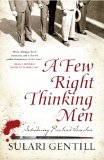
Sulari Gentill's 'Rowland Sinclair' series goes from strength to strength. She is such a refreshing new voice in Australian crime writing: no brutalized female corpses; barely a hint of sex; lots of solid historical background (and some wonderful bits from old newspapers), memorable characters, classic locations, and a sprinkling of little historical and literary riddling to tease the reader. I reviewed her first book (A Few Right Thinking Men) here, and have recently devoured the next three in the series. 


The second in the series is A Decline in Prophets. I was wondering how Gentill would manage her large cast of regular characters, and a highlight of this book was how she took her time to flesh out the groups' dynamics. Their witty badinage is a delight. We discover our hero Rowly - semi-voluntarily exiled from Australia after his disastrous run-in with the New Guard - travelling in style on RMS Aquitania, along with a group of Theosophists (including Annie Besant), a hot-headed Catholic Bishop, various eligible young ladies, and - of course - his faithful coterie of Clyde the artist, Milt the Red poet, and Edna, sculptress and unattainable love of Rowly's life. The action shifts - with murders aplenty - from the luxuries of life onboard to New York (where Edna makes a hit with one Archie Leach) then back to Sydney. Mysterious pregnancies, mad prophets, ambiguous suicides, Masons, mortuary chapels, dodgy poetry, and lots of fun and games. Can the gang make it safely back to lovely Woollahra with a murderer hot in pursuit? And has Rowly pushed his conservative elder brother's tolerance of his Bohemian lifestyle too far this time? A Decline in Prophets won the 2012 Davitt Award for Best Adult Crime Novel by an Australian woman.


The third in the series, Miles Off Course, is, I think (and at the moment!), my favourite. It has such a wonderful Australian setting, moving from the sophisticated high life of the rich in the Blue Mountains to the harsh life of the stockmen who graze their animals in the 'High Country' of the Snowy Mountains. Rowly is sent by his brother Wilfred (a 'Mycroft', and one of my favourite characters - perhaps I relate to being the oldest sibling?) to track down a missing stockman. Harry Simpson is no ordinary stockman - an Aboriginal hand who grew up with the Sinclairs, he is far more than an employee to the Sinclair men. Rowly's stint roughing it in the High Country is more than welcome to him for other reasons: someone is gunning for him - could he be the next high-rolling victim of a spate of abductions? If the travelling snake circus doesn't get him first… This book also has the single best opening line I have read in the last decade. 


No 4., Paving the New Road, offers a change of scene for Rowly and his mates; it is also rather more brutal than its predecessors. It is quite an achievement on Gentill's part to create a veristic 'What If?' as she transports her gang of Bohemian Australian artists to Munich, 1933: "it was decided that they would pose as art dealers. Art was a language they could all speak." Rowly agrees to go to Germany to sabotage the plans of his old enemy Eric Campbell, the New Guard politician who would bring Fascism to Australia. Campbell is touring with members of the British Union of Fascists, whose members include the repellent Unity Mitford (with whom Rowly makes rather a hit). Along the way, Rowly also makes the acquaintance of a young blonde lady called Eva who works for a photographer and has a very secret boyfriend… Gentill does a lovely job manipulating people, events (and dates) to place her hero at the centre of an Australian-led fight against Fascism. There's a lot of humour in this book, despite the grim subject-matter and the knowledge of what is to come for the world. Where will Rowly and co. be in 1939? At the rate Gentill is producing these books, that won't be long! (Two incidental points: does "taught-haired" = tow-haired? And how freaky is it to discover someone you know has given his name to a character. My equilibrium is still awry.) 

If you liked this... for crime-loving history-nerds? It is hard to avoid comparison with Kerry Greenwood's 1920s' heroine Phryne Fisher, who is rich, strong-minded, and (er... unlike Rowly) not always a lady.


Monday, June 11, 2012

{review} the mystery of a hansom cab

Fergus Hume The Mystery of a Hansom Cab (1886) 

On the twenty-seventh day of July, at the hour of twenty minutes to two o'clock in the morning, a hansom cab drove up to the police station in Grey Street, St. Kilda, and the driver made the startling statement that his cab contained the body of a man who he had reason to believe had been murdered.
Fergus Hume has the distinction of writing the first Australian crime novel. It was HUGE - a phenomenon in its time (to borrow from John Sutherland: the "most sensationally popular crime and detective novel of the century" [dodgy source]). However, poor Hume had sold the rights and made sod all from its subsequent wild success. 

Hansom Cab is the story of the investigation into a mysterious murder in, yes, a hansom cab. It is set in Melbourne and, for those who know Melbourne ("Glasgow with the sky of Alexandria"), it is quite a good game to try to figure out how little has changed in that streetscape since Victorian times.
If there is one thing which the Melbourne folk love more than another, it is music. Their fondness for it is only equalled by their admiration for horse-racing. Any street band which plays at all decently, may be sure of a good audience, and a substantial remuneration for their performance. Some writer has described Melbourne, as Glasgow with the sky of Alexandria; and certainly the beautiful climate of Australia, so Italian in its brightness, must have a great effect on the nature of such an adaptable race as the Anglo-Saxon. In spite of the dismal prognostications of Marcus Clarke regarding the future Australian, whom he describes as being "a tall, coarse, strong-jawed, greedy, pushing, talented man, excelling in swimming and horsemanship," it is more likely that he will be a cultured, indolent individual, with an intense appreciation of the arts and sciences, and a dislike to hard work and utilitarian principles.
The story is a fairly typical one: a murder, a corpse without identification, a handful of potential suspects, a lovable dialect-speaking landlady, a determined detective or two, a crime with its roots in the past, and a spot of tender romance.
"You do not regret?" he said, bending his head. "Regret, no," she answered, looking at him with loving eyes. "With you by my side, I fear nothing. Surely our hearts have been tried in the furnace of affliction, and our love has been chastened and purified."
It is quite a good read and a decent shot at sensational fiction. It is hard to imagine how astonishingly original it must have been in its day, since it fits so neatly the stereotypes of the typical crime novel… stereotypes it created. There is apparently a parody of it out there somewhere; it is hard to see how it could beat the original. Its modern day appeal may well now be primarily to Australians as a sort of period piece on Melbourne society, rather than as a crime novel. 

My interest in Hume lies in another area, namely his reuse of ancient themes in other novels that never hit the big-time like Hansom Cab. It is noticeable how often the ancient world pops its head into this book, which is filled with references to popular myth - the sphinx, Midas, asses' ears and so on: "I don't like Latin," said Miss Frettlby, shaking her pretty head. 'I agree with Heine's remark, that if the Romans had been forced to learn it they would not have found time to conquer the world.'" The narrator also suggests that Australians would be cooler if they adopted Greek dress!
It was a broiling hot day--one of those cloudless days, with the blazing sun beating down on the arid streets, and casting deep, black shadows--a real Australian December day dropped by mistake of the clerk of the weather into the middle of August. The previous week having been really chilly, it was all the more welcome. It was Saturday morning, and fashionable Melbourne was "doing the Block." Collins Street is to the Southern city what Bond Street and the Row are to London, and the Boulevards to Paris. It is on the Block that people show off their new dresses, bow to their friends, cut their enemies, and chatter small talk. The same thing no doubt occurred in the Appian Way, the fashionable street of Imperial Rome, when Catullus talked gay nonsense to Lesbia, and Horace received the congratulations of his friends over his new volume of society verses. History repeats itself, and every city is bound by all the laws of civilisation to have one special street, wherein the votaries of fashion can congregate.
This sort of thing may well irritate the hell out of many readers. The book is also frequently interestingly intertextual, which probably should not surprise given that Hume set out in cold-blood to write a popular crime novel based on his reading of other instances of the genre: "Puts one in mind of 'The Leavenworth Case,' and all that sort of thing," said Felix, whose reading was of the lightest description. "Awfully exciting, like putting a Chinese puzzle together. Gad, I wouldn't mind being a detective myself."
"Murdered in a cab," he said, lighting a fresh cigarette, and blowing a cloud of smoke. "A romance in real life, which beats Miss Braddon hollow."
Hume has a great turn of phrase: one character, hot on the trail of scandal, "was one of those witty men who would rather lose a friend than suppress an epigram." And sultry Queensland gets an unforgettable mention: "a profane traveller of an epigrammatic turn of mind once fittingly called it, 'An amateur hell'." 

Rating: a must read for anyone interested in the history of the crime novel or Victorian (in both senses) Australia. (I read a free manybooks.net edition with an unfortunately amount of typos) 

If you liked this: oh, surely "Miss Braddon" (Lady Audley's Secret is a cracker), though Anna Katharine Green's The Leavenworth Case is another marvellous period piece. 

Friday, June 1, 2012

{misc.}


Dim image of dessert train (taken by over-sugared photographer 
with fear of taking photos of food in public and
accompanied by food photography disapproving friend.)

Well, I'm crazy insane busy in a why-did-I-do-this-when-I-could-be-reading-fun-books?-way. 'This' being a paper I am writing for a conference in early July. In Edinburgh. In Scotland (in case there is another Edinburgh somewhere). I haven't given a serious academic paper for so long. Years. Many, many years. Books for fun have certainly fallen by the wayside while I juggle too many things, including my day job which has nothing to do with my other lives.

And my reading plans? I do hope to read something for Beryl Bainbridge week. And I do hope that I will be able to wallow in frivolous reading during the horrific number of hours/days it will take me to get from Australia to Scotland (via - my reward! - Paris).

Anyway, I had a lovely bookish encounter the week before last when, on a quick jaunt from Adelaide to Sydney (primarily to use the university library, though I confess I also used a dessert train to sustain my endeavours), I was taken by a friend to hear Sulari Gentill speak at Sydney Writers' Festival. I had loved her debut historical crime novel, A Few Right Thinking Men {REVIEW}, and was pleased to find the author as quirky and amusing as her book. She was an excellent speaker 'in conversation' about how - and what - she writes. She also grows black truffles and studied both astrophysics and law at university. Afterwards I got to speak with her, while getting the next two books in the Rowland Sinclair series signed (always a thrill to have a signed copy, I think), and she was such a delight.

It is nice when a writer one admires turns out to be a lovely person as well. Incidentally, there was quite a bit of celebrity-spotting available at the festival. At the next signing booth was Dame Stella Rimington. The thrill! And, according to a passerby, Roddy Doyle was sitting next to us at lunch.

The Sulari Gentill books I bought (breaking the book-buying ban that has been in force to fund my 'holiday') were A Decline in Prophets and Miles Off Course (more info via the publisher). If only I had the time to read them...


{READ IN 2018}

  • FEBRUARY
  • 30.
  • 29.
  • 28.
  • 27.
  • 26. The Grave's a Fine & Private Place - Alan Bradley
  • 25. This is What Happened - Mick Herron
  • 24. London Rules - Mick Herron
  • 23. The Third Eye - Ethel Lina White
  • 22. Thrice the Brindled Cat Hath Mewed - Alan Bradley
  • 21. As Chimney Sweepers Come to Dust - Alan Bradley
  • 20. The Dead in Their Vaulted Arches - Alan Bradley
  • 19. Speaking from Among the Bones - Alan Bradley
  • JANUARY
  • 18. Eleanor Oliphant is Completely Fine - Gail Honeyman
  • 17. Miss Ranskill Comes Home - Barbara Euphan Todd
  • 16. The Long Arm of the Law - Martin Edwards (ed.)
  • 15. Nobody Walks - Mick Herron
  • 14. The Talented Mr Ripley - Patricia Highsmith
  • 13. Portrait of a Murderer - Anthony Gilbert
  • 12. Murder is a Waiting Game - Anthony Gilbert
  • 11. Tenant for the Tomb - Anthony Gilbert
  • 10. Death Wears a Mask - Anthony Gilbert
  • 9. Night Encounter - Anthony Gilbert
  • 8. The Visitor - Anthony Gilbert
  • 7. The Looking Glass Murder - Anthony Gilbert
  • 6. The Voice - Anthony Gilbert
  • 5. The Fingerprint - Anthony Gilbert
  • 4. Ring for a Noose - Anthony Gilbert
  • 3. No Dust in the Attic - Anthony Gilbert
  • 2. Uncertain Death - Anthony Gilbert
  • 1. She Shall Died - Anthony Gilbert

{READ IN 2017}

  • DECEMBER
  • 134. Third Crime Lucky - Anthony Gilbert
  • 133. Death Takes a Wife - Anthony Gilbert
  • 132. Death Against the Clock - Anthony Gilbert
  • 131. Give Death a Name - Anthony Gilbert
  • 130. Riddle of a Lady - Anthony Gilbert
  • 129. And Death Came Too - Anthony Gilbert
  • 128. Snake in the Grass - Anthony Gilbert
  • 127. Footsteps Behind Me - Anthony Gilbert
  • 126. Miss Pinnegar Disappears - Anthony Gilbert
  • 125. Lady-Killer - Anthony Gilbert
  • 124. A Nice Cup of Tea - Anthony Gilbert
  • 123. Die in the Dark - Anthony Gilbert
  • 122. Death in the Wrong Room - Anthony Gilbert
  • 121. The Spinster's Secret - Anthony Gilbert
  • 120. Lift up the Lid - Anthony Gilbert
  • 119. Don't Open the Door - Anthony Gilbert
  • 118. The Black Stage - Anthony Gilbert
  • 117. A Spy for Mr Crook - Anthony Gilbert
  • 116. The Scarlet Button - Anthony Gilbert
  • 115. He Came by Night - Anthony Gilbert
  • 114. Something Nasty in the Woodshed - Anthony Gilbert
  • NOVEMBER
  • 113. Death in the Blackout - Anthony Gilbert
  • 112. The Woman in Red - Anthony Gilbert
  • 111. The Vanishing Corpse - Anthony Gilbert
  • 110. London Crimes - Martin Edwards (ed.)
  • 109. The Midnight Line - Anthony Gilbert
  • 108. The Clock in the Hatbox - Anthony Gilbert
  • 107. Dear Dead Woman - Anthony Gilbert
  • 106. The Bell of Death - Anthony Gilbert
  • 105. Treason in my Breast - Anthony Gilbert
  • 104. Murder has no Tongue - Anthony Gilbert
  • 103. The Man who Wasn't There - Anthony Gilbert
  • OCTOBER
  • 102. Murder by Experts - Anthony Gilbert
  • 101. The Perfect Murder Case - Christopher Bush
  • 100. The Plumley Inheritance - Christopher Bush
  • 99. Spy - Bernard Newman
  • 98. Cargo of Eagles - Margery Allingham & Philip Youngman Carter
  • 97. The Mind Readers - Margery Allingham
  • SEPTEMBER
  • 96. The China Governess - Margery Allingham
  • 95. Hide My Eyes - Margery Allingham
  • 94. The Beckoning Lady - Margery Allingham
  • 93. The Tiger in the Smoke - Margery Allingham
  • 92. More Work for the Undertaker - Margery Allingham
  • 91. Coroner's Pidgin - Margery Allingham
  • 90. Traitor's Purse - Margery Allingham
  • 89. The Fashion in Shrouds - Margery Allingham
  • 88. The Case of the Late Pig - Margery Allingham
  • 87. Dancers in Mourning - Margery Allingham
  • AUGUST
  • 86. Flowers for the Judge - Margery Allingham
  • 85. Death of a Ghost - Margery Allingham
  • 84. Sweet Danger - Margery Allingham
  • 83. Police at the Funeral - Margery Allingham
  • 82. Look to the Lady - Margery Allingham
  • 81. Mystery Mile - Margery Allingham
  • 80. The Crime at Black Dudley - Margery Allingham
  • 79. The White Cottage Mystery - Margery Allingham
  • 78. Murder Underground - Mavis Doriel Hay
  • 77. No Man's Land - David Baldacci
  • 76. The Escape - David Baldacci
  • 75. The Forgotten - David Baldacci
  • 74. Zero Day - David Baldacci
  • JULY
  • 73. Pilgrim's Rest - Patricia Wentworth
  • 72. The Case is Closed - Patricia Wentworth
  • 71. The Watersplash - Patricia Wentworth
  • 70. Lonesome Road - Patricia Wentworth
  • 69. The Listening Eye - Patricia Wentworth
  • 68. Through the Wall - Patricia Wentworth
  • 67. Out of the Past - Patricia Wentworth
  • 66. Mistress - Amanda Quick
  • 65. The Black Widow - Daniel Silva
  • 64. The Narrow - Michael Connelly
  • 63. The Poet - Michael Connelly
  • 62. The Visitor - Lee Child
  • 61. No Middle Name: The Complete Collected Jack Reacher Stories - Lee Child
  • JUNE
  • 60. The Queen's Accomplice - Susan Elia MacNeal
  • 59. Mrs Roosevelt's Confidante - Susan Elia MacNeal
  • 58. The PM's Secret Agent - Susan Elia MacNeal
  • 57. His Majesty's Hope - Susan Elia MacNeal
  • 56. Princess Elizabeth's Spy - Susan Elia MacNeal
  • 55. Mr Churchill's Secretary - Susan Elia MacNeal
  • 54. A Lesson in Secrets - Jacqueline Winspear
  • 53. Hit & Run - Lawrence Block
  • 52. Hit Parade - Lawrence Block
  • 51. Hit List - Lawrence Block
  • 50. Six Were Present - E. R. Punshon
  • 49. Triple Quest - E. R. Punshon
  • MAY
  • 48. Dark is the Clue - E. R. Punshon
  • 47. Brought to Light - E. R. Punshon
  • 46. Strange Ending - E. R. Punshon
  • 45. The Attending Truth - E. R. Punshon
  • 44. The Golden Dagger - E. R. Punshon
  • 43. The Secret Search - E. R. Punshon
  • 42. Spook Street - Mick Herron
  • 41. Real Tigers - Mick Herron
  • 40. Dead Lions - Mick Herron
  • 39. Slow Horses - Mick Herron
  • APRIL
  • 38. Everybody Always Tells - E. R. Punshon
  • 37. So Many Doors - E. R. Punshon
  • 36. The Girl with All the Gifts - M. R. Carey
  • 35. A Scream in Soho - John G. Brandon
  • 34. A Murder is Arranged - Basil Thomson
  • 33. The Milliner's Hat Mystery - Basil Thomson
  • 32. Who Killed Stella Pomeroy? - Basil Thomson
  • 31. The Dartmoor Enigma - Basil Thomson
  • 30. The Case of the Dead Diplomat - Basil Thomson
  • 29. The Case of Naomi Clynes - Basil Thomson
  • 28. Richardson Scores Again - Basil Thomson
  • 27. A Deadly Thaw - Sarah Ward
  • MARCH
  • 26. The Spy Paramount - E. Phillips Oppenheim
  • 25. The Great Impersonation - E. Phillips Oppenheim
  • 24. Ragdoll - Daniel Cole
  • 23. The Case of Sir Adam Braid - Molly Thynne
  • 22. The Ministry of Fear - Graham Greene
  • 21. The Draycott Murder Mystery - Molly Thynne
  • 20. The Murder on the Enriqueta - Molly Thynne
  • 19. The Nowhere Man - Gregg Hurwitz
  • 18. He Dies and Makes No Sign - Molly Thynne
  • FEBRUARY
  • 17. Death in the Dentist's Chair - Molly Thynne
  • 16. The Crime at the 'Noah's Ark' - Molly Thynne
  • 15. Harriet the Spy - Louise Fitzhugh
  • 14. Night School - Lee Child
  • 13. The Dancing Bear - Frances Faviell
  • 12. The Reluctant Cannibals - Ian Flitcroft
  • 11. Fear Stalks the Village - Ethel Lina White
  • 10. The Plot - Irving Wallace
  • JANUARY
  • 9. Understood Betsy - Dorothy Canfield Fisher
  • 8. Give the Devil his Due - Sulari Gentill
  • 7. A Murder Unmentioned - Sulari Gentill
  • 6. Dead Until Dark - Charlaine Harris
  • 5. Gentlemen Formerly Dressed - Sulari Gentill
  • 4. While She Sleeps - Ethel Lina White
  • 3. A Chelsea Concerto - Frances Faviell
  • 2. Kipps: The Story of a Simple Soul - H. G. Wells
  • 1. Heft - Liz Moore
Free Delivery on all Books at the Book Depository